Table of Contents
▼
Can a non-resident get an EIN without ever setting foot in the US?
Yes. The IRS issues EINs to foreign-owned entities that have no US office, no US employees and no US tax ID for the owner. The only channel closed to you is the online application, which requires an SSN or ITIN. Form SS-4 by fax, mail or international phone is the route that works.
Quick Answer: A non-resident can get an EIN for a US LLC or corporation by filing Form SS-4 by fax, mail or the IRS international phone line. No SSN or ITIN is required. You leave the SSN/ITIN boxes blank and enter a foreign passport or national ID number on Line 7b. The EIN belongs to the entity, not to you personally.
An EIN is the federal tax ID number for a business, tax-exempt organisation or other entity [2]. It is nine digits, it is free, and it is issued by the IRS, not by a state. Your Wyoming or Delaware filing created the company. The EIN is what lets that company be taxed, banked and paid.
Four numbers get mixed up constantly. Keep them apart:
- SSN - a Social Security number, issued to US citizens and authorised workers. You do not have one and you are not applying for one.
- ITIN - an Individual Taxpayer Identification Number, issued by the IRS to people who need to file a US individual return but cannot get an SSN. It is personal, not corporate.
- TIN - the umbrella term. An SSN, an ITIN and an EIN are all TINs. When a bank form asks for a TIN, an EIN satisfies it.
- EIN - the entity's number. This is the one you are here for.
One correction before you go further: the EIN does not replace your state formation documents, and it does not register you for state tax. Wyoming does not know or care that you have an EIN. If your state requires a separate sales tax or withholding account, that is a second registration with a second agency.
Say your LLC was formed in Wyoming in March and you live in Pune. You file SS-4, get the EIN in April, and open a Mercury account in May. None of those steps touch the Wyoming Secretary of State. Your annual report there is a separate obligation with a separate deadline.
Who actually applies - the entity or the owner?
The entity applies. A foreign-owned LLC, a C-corp and a partnership each get their own EIN, and that number is separate from every owner's personal tax identity. You sign the form as the responsible party, but the applicant is the company.
The one exception: a sole proprietor with no entity at all applies as an individual. If you formed an LLC, that is not you.
Order matters here. The SS-4 asks for the entity's legal name, the state where it was formed, and the date it started. You cannot answer those before the Articles of Organization are filed and accepted. Form the company first, then apply for the EIN. Founders who reverse it end up faxing an amended SS-4.
A foreign company can also need an EIN. If an Indian private limited company opens a US branch, holds US real estate, or has US-source income subject to withholding, it files the same SS-4. The form does not change. The answers do.
If the company does not exist yet, start with US LLC formation for non-residents and come back to this page once the state has issued your filed-stamped documents.
Filling out Form SS-4 when you have no SSN or ITIN
Leave the SSN and ITIN boxes empty and put your foreign ID on Line 7b. The SS-4 instructions allow a passport number or national ID number for a responsible party who has no US tax ID. That single line is what makes the form workable for a non-resident.
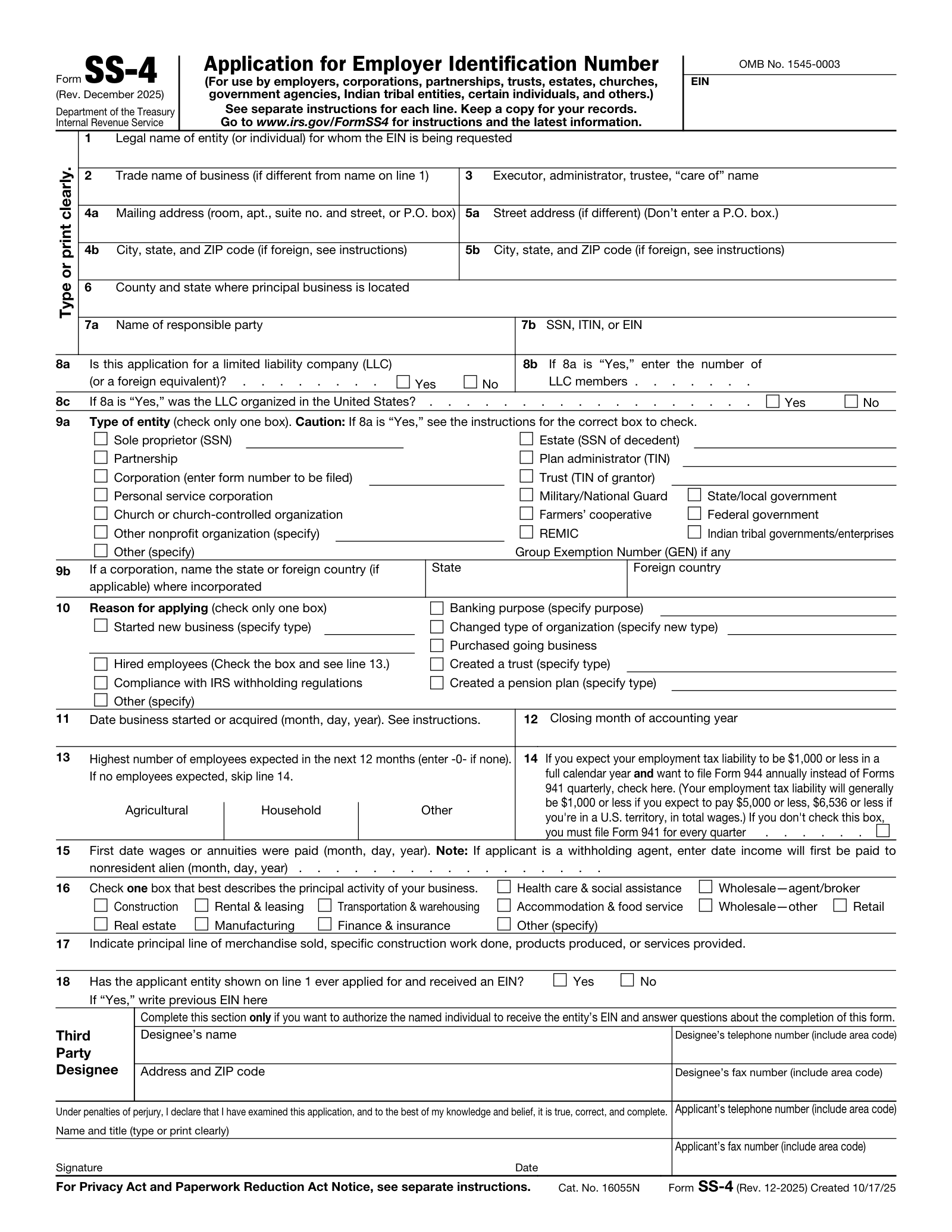
Official form (IRS.gov): Form SS-4 official PDF
Here is what goes where, in the order you will type it.
Line 1 - legal name. Exactly as it appears on the Articles of Organization, including the suffix (LLC, Inc., Corp.). If the state recorded "Nimbus Labs LLC" and you type "Nimbus Labs", the IRS may bounce it back.
Line 2 - trade name. Your brand name, if it differs. Otherwise blank.
Line 3 - executor, administrator, trustee. N/A for almost every founder reading this.
Line 4a/4b - mailing address. This is where the IRS sends the EIN confirmation. A foreign address is acceptable. Read the delivery section below before you commit to your Indian address.
Line 5a/5b - street address. The entity's physical US location. If your registered agent provides a business address, use it. If you have no US address at all, the IRS instructions allow you to enter your foreign address here too.
Line 6 - county and state. The county where the company was formed, and the state of formation. For a Wyoming LLC registered in Cheyenne, that is Laramie County, WY.
Line 7a/7b - responsible party. Your full legal name on 7a, your passport number on 7b. Detailed below.
Line 8 - entity type. The checkboxes. Most non-resident founders tick LLC and enter the number of members. A corporation ticks Corporation and then the tax-form sub-box (1120 for a standard C-corp).
Line 9 - other entity type. Only if you ticked "Other" on Line 8. Write the description. Do not use this to explain your business.
Line 10 - reason for applying. Started new business, banking purpose, or compliance with IRS withholding. More on this below.
Line 11 - date business started. The date the state accepted your formation filing, not the date you had the idea.
Line 12 - closing month of accounting year. December for nearly everyone. Change it only if you have a real fiscal year and a reason.
Line 13 - employees. Zero is a valid and common answer. Do not inflate it.
Line 14 - agricultural employees. N/A.
Line 15 - prior EIN. Blank unless you are re-applying after losing one.
Line 16 - prior return. Blank for a new entity.
Line 17 - description of business. Short and concrete: "software development", "e-commerce retail", "consulting". Not a paragraph.
Line 18 - third-party designee. This is the line that solves the delivery problem. Covered below.
The trap that catches most people is Line 7a. It is not the company name. It is a natural person's name, and it must be a human being, not another company. If your LLC is owned by a Singapore holding company, you still name the individual behind that holding company.
The responsible party line and what to enter
The responsible party is the natural person who ultimately owns or controls the entity. For a single-member foreign-owned LLC, that is you. Full legal name on 7a, passport number on 7b, and you do not need an ITIN to be named there.
The IRS wants a human it can contact about the account. That person is not always the person who signs the form, and that distinction matters if your CPA files on your behalf.
Three edge cases come up often:
- Two or more owners. Pick the person with actual control. If ownership is 50/50, pick the managing member and be consistent with what your operating agreement says.
- Owned by another company. Name the individual who controls the parent. The IRS will not accept a corporate name on 7a.
- Held in a trust. The trustee or the grantor, depending on who controls the entity. This is the one case where I would get a tax professional to confirm before filing.
Suppose you and a co-founder each own 50% of a Delaware LLC and both live in Bengaluru. You name yourself on 7a, put your passport number on 7b, and your co-founder's name appears nowhere on the form. That is correct. The operating agreement is where the 50/50 split lives.
Which entity type and reason-for-applying box fits your structure?
Tick the box that matches your legal form, then make sure the tax return the IRS expects is the one you actually intend to file. Line 8 is not cosmetic. It sets the IRS's expectation for your first filing season.
| Entity | Line 8 box | Default federal return | Form 5472? |
|---|---|---|---|
| Single-member LLC, foreign owner | LLC, 1 member | Pro forma Form 1120 with Form 5472 attached | Yes |
| Multi-member LLC, all foreign owners | LLC, 2+ members | Form 1065 partnership return | Yes, if a foreign owner has reportable transactions |
| C-corporation, foreign-owned | Corporation (1120) | Form 1120 | Yes, on reportable transactions with foreign related parties |
| Foreign company with a US branch | Other | Depends on the branch's activity | Check with a tax professional |
That first row is the one almost nobody explains at formation. A single-member LLC owned by a non-resident is disregarded for US federal tax purposes by default. It still has to file an annual return: a pro forma Form 1120 with Form 5472 attached, reporting transactions between the LLC and its foreign owner. Skip it and the penalty is steep.
Line 10, the reason for applying, changes what the IRS expects next. Started new business is the honest answer for a freshly formed company. Banking purpose is for an entity that exists for another reason and needs the EIN only to open an account. Compliance with IRS withholding is for entities that will withhold on payments to foreign persons. Pick the true one. If you tick banking purpose and then file a corporate return, you have created a question you did not need.
Form 8832, the entity classification election, is a different form for a different purpose. A default single-member LLC does not need it. File it only if you are electing corporate treatment on purpose, and get advice first. For the downstream filing, see federal tax support for Form 5472 and Form 1120.
Fax, mail, or international phone - which submission route works?
Fax is the practical choice for most non-residents. Mail works but is slow. The international phone line can issue an EIN on the call if the agent can verify you, and it is the only same-day route.
The online application is out. It requires an SSN or ITIN and a US address, and the IRS does not accept email submissions from applicants without one [4].
| Channel | Open to non-residents | Typical turnaround | How you receive the EIN |
|---|---|---|---|
| Online | No | N/A | N/A |
| Fax | Yes | Days to a few weeks | Fax back, or mail to Line 4a |
| Yes | Weeks | Mail to Line 4a | |
| International phone | Yes | Same call, if verification succeeds | Read to you on the call, then mailed |
Heads-up: the IRS fax number for international applicants and the phone line hours change. Confirm both on the IRS "Get an EIN" page before you send anything, and never use a fax number copied from a blog post
Line 18 is the part that makes fax genuinely useful. Name a third-party designee, such as your CPA or the agent who formed the company, and the IRS can fax the EIN to that person instead of mailing it to your address overseas. The designee must sign Line 18. Without a signature the designation is void, and the EIN goes back to the mail queue.
Imagine you are in Hyderabad, the IRS faxes your EIN to your accountant in Texas, and she forwards a scan to you within the hour. You have a working EIN the same week. That is Line 18 doing its job.
What happens when the IRS asks for more information
The IRS may fax or mail a request for clarification before issuing the EIN. Answer it on the same channel, quote the reference number on the notice, and keep a copy of everything you send. If you do not respond, the application is closed and you start again from a blank SS-4.
The usual triggers are boring and fixable:
- Line 7a has a company name instead of a person's name.
- The legal name on Line 1 does not match the state filing character for character.
- Line 10 is inconsistent with the entity type on Line 8.
- Line 7b is blank because you assumed the IRS would look you up.
A closed application creates no tax liability. It does create a delay, and if your bank onboarding or your first Stripe payout depends on the EIN, the delay is the real cost. Fix the specific line the notice names, refax, and note the date you sent it.
How the EIN reaches an overseas address - and how to use it
The IRS mails the EIN confirmation to the address on Line 4a. If that address is in India, delivery takes weeks and sometimes does not arrive at all. Use a US mailing address on 4a or name a third-party designee on Line 18.
The confirmation letter is CP 575, the original notice. If you lose it, the IRS issues a 147C replacement letter on request. Banks accept either, but a printed CP 575 with the IRS letterhead is the one they ask for first.
| Delivery method | Speed | What the bank accepts |
|---|---|---|
| Fax back to third-party designee | Fastest | CP 575 fax or scan |
| Mail to a US address | Days to weeks | CP 575 original |
| Mail to an overseas address | Weeks | CP 575 original, if it arrives |
| 147C replacement | Varies | 147C letter |
Once you have the number, the EIN goes on your bank application, your Stripe or Wise Business onboarding, and your state and federal filings. Payment platforms ask foreign-owned entities for Form W-8BEN-E, not Form W-9. A W-9 is for US persons. Getting that wrong stalls onboarding for weeks.
If you want the account side handled in parallel, see opening a US business bank account as a non-resident. An EIN makes you eligible to apply. Approval stays with the bank, and no one can promise it.
Common Mistakes
Putting the company name on Line 7a. The responsible party is a person. This is the single most common reason an SS-4 gets bounced.
Applying before the state filing is accepted. Line 11 needs a real start date. Wait for the filed-stamped Articles of Organization.
Leaving Line 7b blank. The SSN/ITIN boxes stay empty, but 7b is where your passport number goes. An empty 7b gives the IRS nothing to verify.
Using a virtual mailbox on Line 5a without checking the registered agent rules. Some agents provide a business address, some provide only a registered agent address. They are not the same thing, and the IRS wants a street address.
Ticking "banking purpose" because it sounds faster. It does not speed anything up. It just misdescribes the entity.
Forgetting Form 5472 the following year. The EIN is step one. The annual filing is the obligation that comes with it.
Frequently Asked Questions
Can I get an EIN without an SSN or ITIN? Yes. Leave the SSN/ITIN boxes blank and enter your passport or national ID number on Line 7b.
How long does an EIN take for a non-resident? Fax takes days to a few weeks, mail takes longer, and the international phone line can issue it on the call if verification succeeds. Check current IRS timelines before you plan around them.
Can my formation agent or CPA apply for the EIN on my behalf? Yes. Name them on Line 18 as the third-party designee and have them sign it, so the IRS can fax the EIN to them.
Does a single-member foreign-owned LLC need an EIN? Yes. You need it to open a bank account and to file the pro forma Form 1120 with Form 5472 each year.
What address do I put on Form SS-4 if I live in India? A foreign address is acceptable on Line 4a. Line 5a can be the registered agent or principal US address.
Is the EIN the same as a state business license? No. The EIN is federal only. State registration and any state tax accounts are separate.
If you want help with US LLC formation, EIN and business setup, NexFyla can assist with the SS-4 filing and the banking introduction that follows it.
*Last updated: February 2026.*