Table of Contents
▼
What is an EIN and why do you need one as a non-US resident?
An EIN is a free nine-digit federal tax ID number issued by the IRS to businesses. Non-US residents need one to open a US business bank account, use payment processors like Stripe and PayPal, file US tax returns, and hire employees.
Quick Answer: A non-US resident can get an EIN without an SSN or ITIN by filing IRS Form SS-4 by fax or mail. The EIN is free, issued by the IRS, and used for banking, payments, and tax filing. Fax processing typically takes 5–15 business days; mail takes 4–6 weeks [1].
An EIN is not the same thing as an SSN, ITIN, or TIN, and mixing them up is the single most common reason non-residents get stuck before they even start.
- SSN (Social Security Number): for US citizens and authorized workers. You cannot get one from abroad.
- ITIN (Individual Taxpayer Identification Number): for individuals who must file a US personal tax return but cannot get an SSN. It is issued by the IRS but is not an EIN.
- TIN (Taxpayer Identification Number): the umbrella term. An EIN, SSN, and ITIN are all TINs.
- EIN (Employer Identification Number): the business tax ID. This is what you want.
If you have formed a US LLC or corporation — or plan to — you need an EIN. The IRS issues EINs for free, directly, and the number belongs to the entity, not to you personally [9].
You need one even if you have no US employees, no US office, and no plans to set foot in the country. A foreign-owned single-member LLC that is treated as a disregarded entity still has to file Form 5472 (an information return for foreign-owned US corporations and LLCs) and it still needs an EIN to do that. Banking and payment processing come first in practice, though — most US banks and Stripe will not open an account or approve a merchant profile without an EIN.
If you are still deciding on the entity itself, our [INTERNAL LINK: US LLC formation] guide covers state choice and filing.
Why can't non-residents use the IRS online EIN tool?
The IRS online EIN tool requires a valid SSN or ITIN, and it is reserved for entities with US addresses and US taxpayer IDs. Non-residents apply with Form SS-4 instead — by fax or mail [7].
That is the whole answer. The online tool is fast and free, but it will reject an application that has a foreign address in the principal place of business field or a responsible party without an SSN or ITIN. The IRS designed it for US persons, and it stays that way.
Here is the part people get wrong: you do not need an SSN or ITIN to get an EIN. You need one to use the *online* tool. Those are different requirements, and the second one does not apply to you.
Do not apply for an ITIN just to use the online tool. An ITIN application (Form W-7) can take months, requires you to send your passport or a certified copy to the IRS, and buys you nothing here — you would still be filing Form SS-4 by fax or mail anyway. Skip it.
Who is eligible for an EIN as a non-resident?
Non-resident individuals, foreign corporations, foreign partnerships, non-US trusts, and foreign-owned LLCs that do business in the US or must file a US tax return are all eligible to apply for an EIN [2][10].
Eligibility is not about citizenship or residency. It is about whether the entity has a US tax filing or withholding obligation, or needs the number for a US bank or payment processor. The IRS list includes entities that:
- Have employees or plan to hire in the US
- Have excise tax liability
- Withhold taxes on income paid to a non-resident alien
- File a return for a foreign-owned disregarded entity (Form 5472)
- Need an EIN for banking, credit, or payment processing
A single-member LLC owned by a non-resident is a disregarded entity for federal tax purposes by default. It has no separate income tax return of its own — but it must file Form 5472 with a pro forma Form 1120, and to do that it needs an EIN. This is the exact case most guides skip over.
You can apply for an EIN with no US bank account, no US office, and no US phone number. What you cannot do is apply online.
If you have not formed the LLC yet, start with [INTERNAL LINK: EIN for non-US residents] after formation — the order matters, because the SS-4 asks for the entity's formation date and state.
How do you fill out Form SS-4 correctly as a non-resident?
Fill out every required line, put your own name and foreign address in the responsible party section, and leave the SSN/ITIN boxes blank if you do not have one. That is the core of it.
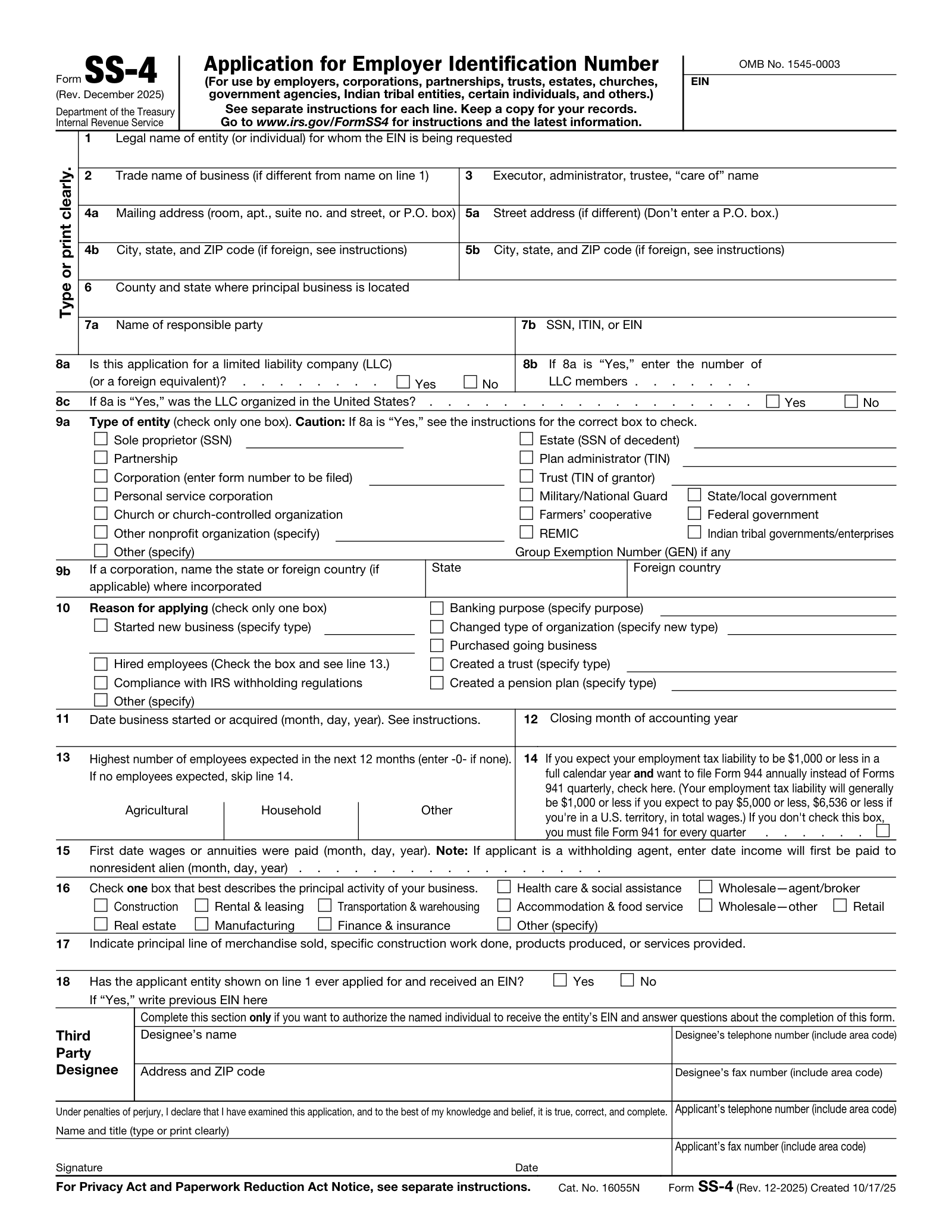
Official form (IRS.gov): Form SS-4 official PDF
Here is the line-by-line that matters for a non-resident LLC:
- Line 1 — Legal name: the exact name on your Articles of Organization (the state filing that creates your LLC). If the state added "LLC" and you left it off, use the state's version.
- Line 2 — Trade name: only if you operate under a different name. Otherwise blank.
- Line 3 — Executor, administrator, trustee: leave blank unless it applies.
- Line 4a/4b — Mailing address: your real mailing address, even if it is outside the US. A registered agent address works if you can receive mail there.
- Line 5a/5b — Street address: your business address. Foreign address is fine.
- Line 6 — County and state where principal business is located: the US state where the LLC is registered.
- Line 7a/7b — Responsible party: your full legal name. This is a person, not the company.
- Line 7b — SSN/ITIN: leave blank if you have neither. Do not invent a number.
- Line 8 — Is this an LLC? Check "Yes" and select the number of members.
- Line 9 — Type of entity: check the box that matches how the LLC is taxed. A single-member LLC owned by a non-resident is usually "Other" with "Disregarded entity" written in.
- Line 10 — Reason for applying: "Banking purposes" or "Started new business" are the usual answers.
- Line 11 — Date business started: the date your LLC was approved by the state.
- Line 12 — Closing month of accounting year: December, unless you have a reason to change it.
- Line 13 — Employees: enter 0 if you have none.
- Line 14 — Excise tax: enter 0 unless it applies.
- Line 15 — First date wages paid: blank if no employees.
- Line 16 — Principal activity: the closest fit for what the business does.
- Line 17 — Describe the business: one sentence is enough.
- Line 18 — Prior EIN: blank if this is the first one.
- Third Party Designee: leave blank unless you want someone else to speak to the IRS for you.
- Signature: sign it. An unsigned SS-4 gets rejected.
Tip: Use the current revision of Form SS-4 from irs.gov. An old revision can trigger a rejection.
Fax vs mail: which method is faster for non-residents?
Fax is faster. Fax applications typically take 5–15 business days; mail takes 4–6 weeks [1]. If you are not in a hurry and want a paper trail, mail is fine. If you need the EIN to open a bank account this month, fax it.
| Method | Timeline | Cost | Requirements | Best for |
|---|---|---|---|---|
| Fax | 5–15 business days [1] | Cost of fax service (varies) | A return fax number the IRS can send the EIN to | Urgent applications |
| 4–6 weeks [1] | Postage | Trackable mail recommended | Applications with no deadline | |
| Online | Minutes | Free | US SSN or ITIN — not available to non-residents | US persons only |
| Phone | Varies | Free | International applicants only; check current availability | Rare cases |
The fax route has one requirement people miss: include a return fax number on the form. The IRS sends the EIN back by fax. If you use an online fax service, confirm it can *receive* faxes, not just send them. A service that only sends will leave you waiting for a notice that never arrives.
Heads-up: the IRS fax number for Form SS-4 and the mailing address change from time to time. Check the current "Where to File Your Taxes" page or the SS-4 instructions before you send anything. ## How long does it take to get an EIN as a non-resident?
Fax: 5–15 business days. Mail: 4–6 weeks [1]. Those are the working numbers, and they assume a complete, correctly signed form.
Incomplete applications are the main cause of delay. A missing signature, a blank responsible party line, or an old form revision can push you to the back of the queue, and you will not get an email telling you why.
What speeds things up:
- Double-check every field against the SS-4 instructions before sending
- Include a return fax number if you are faxing
- Use trackable mail if you are mailing
- Use the current revision of the form
If you have a fax confirmation and it has been longer than the expected window, you can try the IRS international line to check status. ## What should you do after submitting Form SS-4?
Wait for the IRS to assign the EIN and send it back — by fax if you provided a return fax number, or by mail as a CP 575 notice. You can start using the EIN as soon as it is assigned, even before the notice arrives.
If the expected window passes with nothing:
- Check your fax service's received-fax log. The EIN may already be sitting there.
- Call the IRS international line with your fax confirmation and entity details.
- If the IRS rejected the application, correct the errors and resubmit by fax or mail.
Keep the CP 575 notice. Banks, payment processors, and your accountant will ask for it, and replacing a lost notice takes another IRS request. If you never receive the notice but the IRS has assigned the number, you can request a letter confirming the EIN.
Once the EIN is in hand, the next practical steps are a [INTERNAL LINK: US business bank account] and [INTERNAL LINK: payment setup] with Stripe or a similar processor. Both will ask for the EIN, the formation documents, and proof of address for the responsible party.
Common Mistakes
- Applying online. The online tool blocks non-residents. Use Form SS-4 by fax or mail [7].
- Leaving the responsible party blank. The IRS requires a named individual who controls the entity. A blank line gets the form rejected.
- Writing a fake or borrowed SSN. Never do this. Leave the SSN/ITIN field blank if you have neither.
- Applying for an ITIN first. Unnecessary for an EIN and it can add months.
- Using an old Form SS-4 revision. Download the current one from irs.gov.
- Forgetting to sign. An unsigned form is an automatic reject.
- No return fax number. If you fax without one, the IRS has nowhere to send the EIN.
- Wrong entity classification on Line 9. A single-member LLC owned by a non-resident is a disregarded entity by default. Checking the wrong box can cause an incorrect EIN assignment and a headache at tax time.
- Paying a third party for something the IRS does free. The EIN itself costs nothing. Services charge for the paperwork, not the number.
Frequently Asked Questions
Can I get an EIN without an SSN or ITIN? Yes. Non-residents apply with Form SS-4 by fax or mail. No SSN or ITIN is required [1].
How long does it take to get an EIN by fax? Typically 5–15 business days, assuming the form is complete and includes a return fax number [1].
What is the responsible party on Form SS-4 for a non-resident? The individual who controls the entity. Enter your full name and foreign address, and leave the SSN/ITIN field blank if you have neither.
Can I apply for an EIN online as a non-resident? No. The online tool requires an SSN or ITIN. Use fax or mail [7].
Do I need an EIN for a single-member LLC as a non-resident? Yes, if the LLC is foreign-owned and files Form 5472. A disregarded entity still needs its own EIN for that filing.
What if my SS-4 is rejected? Correct the errors and resubmit by fax or mail. You can also call the IRS international line for guidance.
Does an EIN mean I owe US tax? No. An EIN is an ID number, not a tax bill. Whether you owe US tax depends on your ownership, your US-source and effectively connected income, any treaty position, state nexus, and how the entity is classified. Talk to a qualified tax professional about your situation.
NexFyla helps non-US founders form US companies and set up EIN and US business banking support. If you want help with US LLC formation, EIN and business setup, NexFyla can assist.
*Last updated: February 2026.*
Sources
- [1] Stripe — How to get an EIN or a TIN while living outside the US: https://stripe.com/resources/more/how-to-get-an-ein-or-a-tin-while-living-outside-the-us
- [2] Wise — How to Get an EIN for Foreigners: Complete Guide: https://wise.com/us/blog/ein-for-foreigners
- [7] Stripe — How to get an EIN or a TIN while living outside the US: https://stripe.com/resources/more/how-to-get-an-ein-or-a-tin-while-living-outside-the-us
- [9] IRS — Employer identification number: https://www.irs.gov/businesses/employer-identification-number
- [10] Wise — How to Get an EIN for Foreigners: Complete Guide: https://wise.com/us/blog/ein-for-foreigners