Table of Contents
▼
Why do non-resident EIN requests take longer than domestic ones?
Because the IRS online EIN assistant is closed to you. That tool requires a valid Social Security Number or ITIN for the person applying, and without one you drop into the manual lane: fax or mail on Form SS-4 [1]. Manual means human review, batches, and a paper trail you have to chase yourself.
Quick Answer: A non-US resident gets an EIN by fax or mail on Form SS-4, not online, because the online assistant requires an SSN or ITIN. The IRS targets about 4 business days for fax requests and up to 4-6 weeks for mail, but that clock starts only when a complete, legible form reaches the right office. Most delays are form errors, not queue length.
An EIN is the nine-digit tax ID the IRS assigns to your LLC. You need it to open a US business bank account, connect Stripe, and file your annual return. No EIN, no account, no filing.
That is the whole reason speed matters. You are not chasing a number for its own sake. You are chasing the bank onboarding and the tax deadline behind it.
One more layer of friction: an SS-4 with no US tax ID in the Responsible Party block gets closer reading than a domestic one. A single blank field turns into a written request for more information, and that letter resets your timeline from zero.
If you have not formed the company yet, the entity paperwork comes first. Read US LLC formation for non-residents before you touch the SS-4.
Fax, mail, or phone: which EIN channel is actually fastest for a foreign applicant?
Fax wins. It is the fastest self-serve channel for a non-US resident. Phone only works if you already hold an SSN or ITIN, and mail is the fallback nobody should choose unless fax is impossible.
| Channel | Who can use it | Typical turnaround | Proof of delivery | Main failure mode |
|---|---|---|---|---|
| Online assistant | Applicants with SSN/ITIN only | Same session | None needed | Not available to you |
| Fax (Form SS-4) | Any applicant | About 4 business days per IRS | Fax confirmation page | Wrong fax number, illegible copy |
| Mail (Form SS-4) | Any applicant | Up to 4-6 weeks per IRS | Courier tracking only | Lost post, no return receipt |
| Phone | SSN/ITIN holders | Immediate | None | Blocked without a US tax ID |
The government fee for an EIN is $0 on every channel [1]. Your only cost is a fax service or a courier, and your time.
The IRS publishes separate domestic and international fax numbers on the Form SS-4 instructions. Numbers move. Check irs.gov the morning you send, not a screenshot from a blog.
Keep the fax confirmation page. It is the only receipt a DIY filer gets, and it is the document you quote when you call the IRS three weeks later. Save it with date and time in the filename.
The field-by-field walkthrough lives in getting an EIN as a non-US resident without an SSN. Read it before you fill anything in.
Which SS-4 fields most often trigger an IRS delay?
The Responsible Party block, the reason-for-applying box, the entity type line, and blank fields that should say "N/A". Those four cause most of the pain.
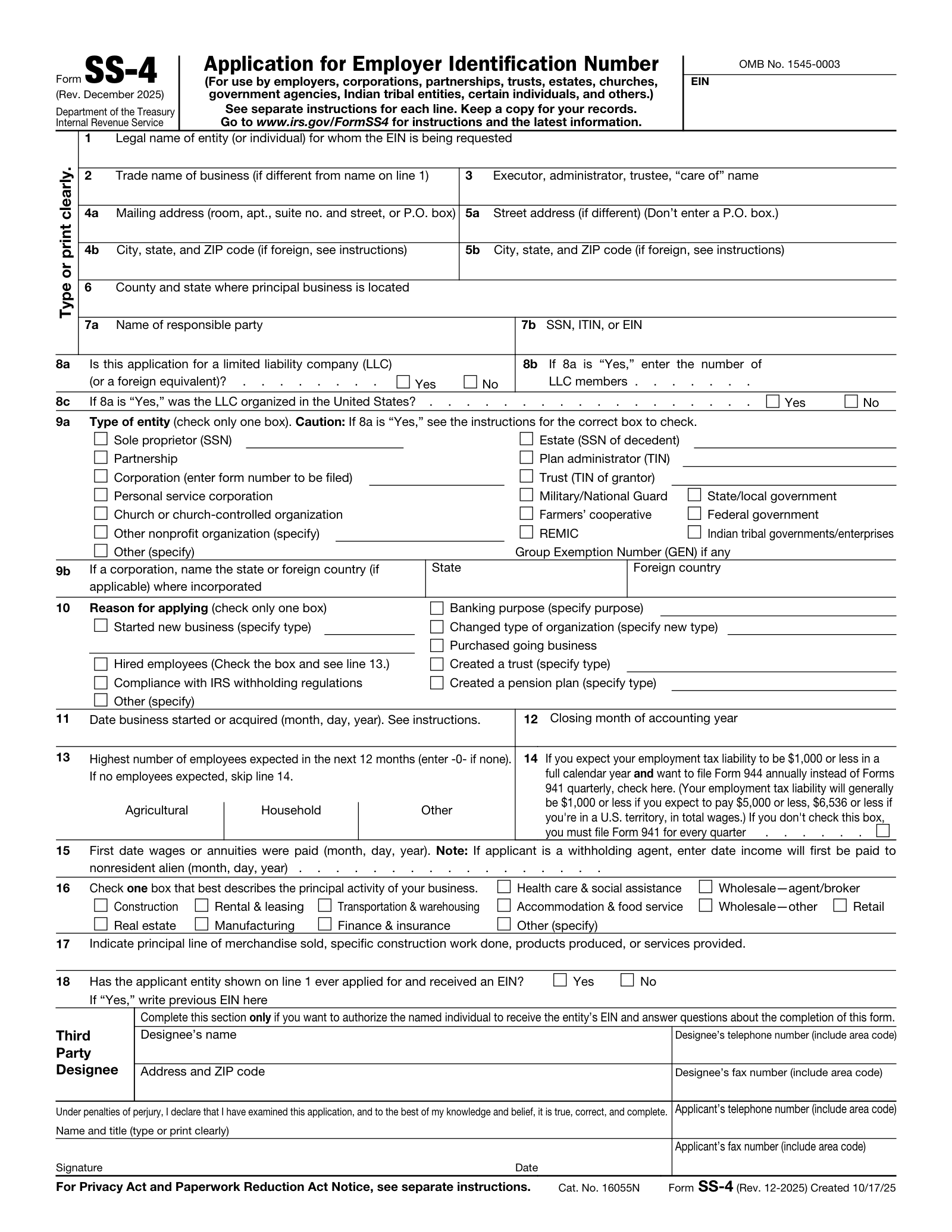
Official form (IRS.gov): Form SS-4 official PDF
Line 7b is where people freeze. It asks for the Responsible Party's SSN or ITIN, and you have neither. The answer is to write "Foreign" in that field. Leaving it blank is the single most common reason a non-resident SS-4 bounces back.
Line 9 is the reason for applying. Tick a box. "Started new business" or "Banking purpose" both fit a new LLC. An empty line 9 tells the IRS nothing and invites a follow-up.
Line 8a is the entity type, and it has to match your state formation document word for word. If Delaware lists you as a "Limited Liability Company" and your SS-4 says "LLC," you have created a mismatch a clerk has to resolve by mail.
Blank fields are not neutral. The IRS instructions tell filers to write "N/A" where a line does not apply. A blank looks like an omission. "N/A" looks like a decision.
Say your Wyoming LLC was formed as "Northwind Trading LLC" but your SS-4 reads "Northwind Trading Co." The IRS has no record tying those names together, so the request sits in a mismatch pile while someone tries to reconcile it. You find out six weeks later, by letter.
How do you avoid a request for additional information?
Send one complete, legible, single-sided fax with every applicable line filled. That is the whole trick. The IRS letter asking for more information is almost always preventable.
Run this checklist before you dial:
- Legal name matches the state formation document exactly, including "LLC"
- Entity type on line 8a matches that same document
- Line 7b shows your SSN/ITIN, or the word "Foreign"
- Line 9 has a box ticked
- Every non-applicable line reads "N/A"
- Signature and title present ("Member" or "Manager" works for an LLC)
- Cover page with your return fax number and phone number
- Correct current fax number, checked on irs.gov that day
If a request for additional information does arrive, answer it by the deadline printed on the letter, using the method the letter specifies, and quote its reference number. Do not start a fresh SS-4. A new form is a new request.
You already filed and heard nothing - what should you do next?
Call the IRS before you refile. Confirm receipt first, then decide. Blind refiling is how founders end up with two EINs and a bank that cannot match either one to their records.
Here is the triage:
- Under 4 business days since fax: wait. You are inside the published window.
- 5 to 15 business days, fax confirmed: call the IRS Business & Specialty Tax Line and ask for status.
- Over 15 business days, fax confirmed: call. If the IRS has no record, refile by fax and mark the cover page "second request."
- No fax confirmation at all: assume nothing was received and refile once, cleanly.
Have these ready for the call: entity name exactly as filed, formation date and state, Responsible Party name, your fax confirmation, and any IRS reference number you have been given.
Suppose you faxed on a Monday and heard nothing by the following Wednesday, nine business days later. That is past the target. Call, give the agent your entity name and fax timestamp, and ask whether the SS-4 is on file. If it is, you wait. If it is not, you refile once and note the original date on the cover page.
Can you start banking or contracting before the EIN arrives?
Mostly no for banking. Yes for some contracts. That split matters more than people admit.
A US business bank or fintech account wants the EIN at onboarding, along with your formation documents and ID. No EIN, no application. That is the practical wall, and it is why founders care about the four-day target.
A payment processor needs the EIN plus a bank account, so it sits behind the bank in the queue. A client contract usually needs only your legal entity name and a signature. Payroll needs the EIN, full stop.
Then there is the deadline you cannot see. A foreign-owned single-member LLC files Form 5472 attached to a pro-forma Form 1120, and you need the EIN to file it. A stalled EIN eats into that runway. What you owe depends on ownership, US-source and effectively connected income, treaty position, state nexus and entity classification. Get a qualified tax professional to map those for your facts.
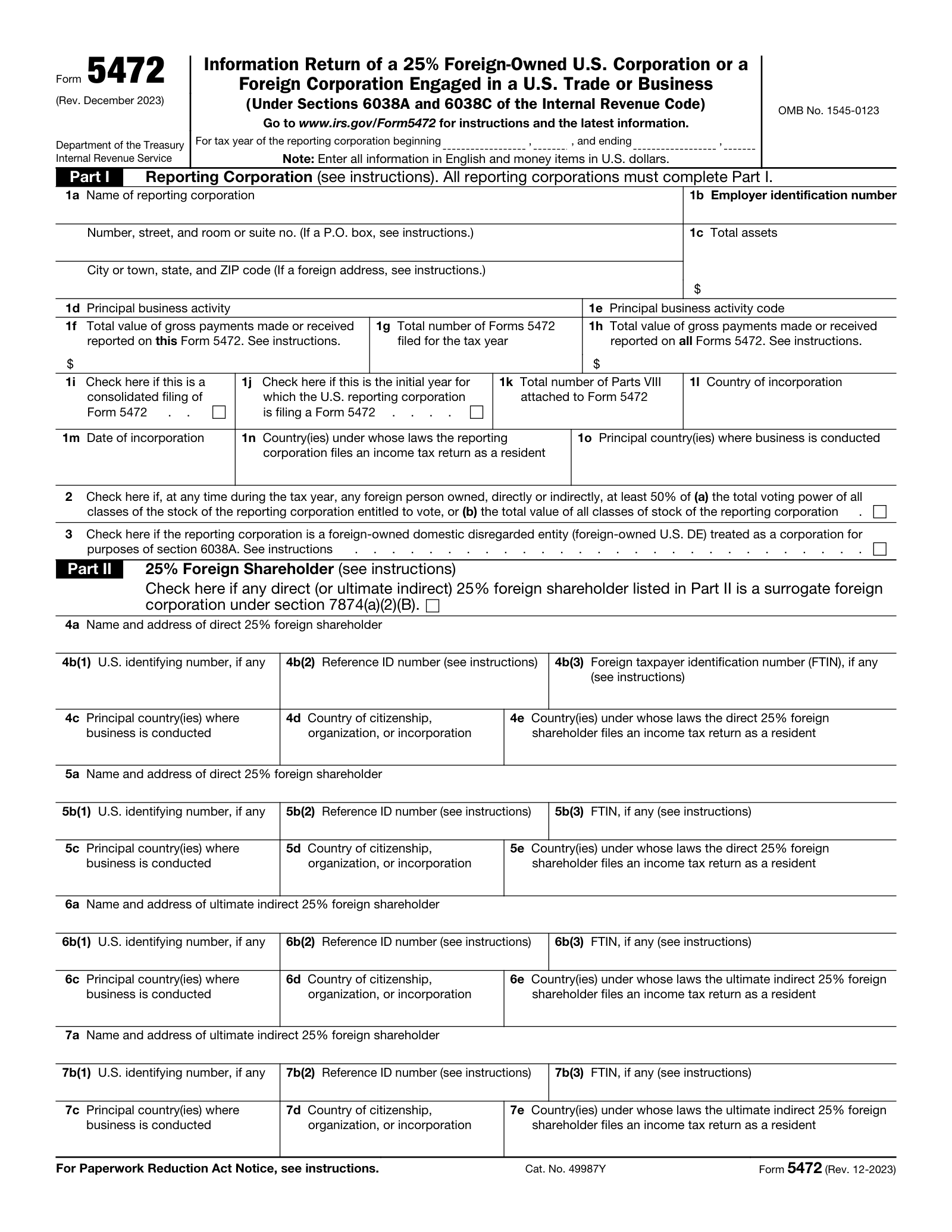
Official form (IRS.gov): Form 5472 official PDF
When the EIN lands, the account step is next. Opening a US business bank account as a non-resident covers what each provider asks for.
How do you follow up without restarting your EIN request?
Call first, keep your original fax confirmation, and resubmit only if the IRS confirms no record exists. A resubmission is a new request, not an escalation. Treat it that way.
International callers may need the number published for callers outside the US rather than the domestic line.
Script the call in four lines: who you are, the entity name and formation date, the date and time you faxed, and the question. "Has the SS-4 been received, and is an EIN assigned?" Then stop talking and let the agent check.
Once the EIN exists, ask for written confirmation by fax. That document is the 147C letter, the IRS's official statement of your EIN, and banks accept it when the CP 575 notice never arrived.
When is a third-party agent worth it, and what does it actually change?
An agent changes who prepares the SS-4 and who chases the follow-up. It does not change the IRS queue. The EIN itself is always free from the IRS [1].
| Route | Government cost | Provider cost | What you actually buy |
|---|---|---|---|
| DIY fax | $0 | Fax service, small | Your own time and error risk |
| Formation bundle | $0 | Varies by provider | Form prep and submission |
| CPA or agent | $0 | Varies by provider | Form prep plus follow-up |
The legitimate mechanism is the third-party designee block on Form SS-4, which authorizes someone to speak with the IRS about your application.
Pay for help in three situations: you have no reliable way to send a fax, you have already received an additional-information letter, or a Form 5472 deadline is close enough that a delay costs you money. Otherwise, DIY is fine and cheap.
Do not pay anyone for the EIN number itself. The IRS issues it free. You are paying for preparation and follow-up, nothing else.
Common Mistakes
- Refiling too early. A second SS-4 can produce a second EIN that conflicts with your bank records and any return already filed under the first.
- Leaving line 7b blank. Write "Foreign" when you have no SSN or ITIN. Blank is the top cause of follow-up letters.
- Name mismatch. The legal name on the SS-4 must match the state formation document exactly, including the "LLC" suffix.
- Using a stale fax number. Numbers change. Check irs.gov on the day you send.
- Trying the online assistant anyway. It rejects applicants without an SSN or ITIN. You will waste an afternoon.
- Paying for the EIN. The number is free. Preparation help is a separate, optional purchase.
- Skipping the fax confirmation. Without it, you cannot prove receipt when you call.
If the filing side is where you want hands off your plate, NexFyla helps non-US founders form US companies and set up EIN and US business banking support. You can see what each package covers on the NexFyla pricing page before you decide anything.
Frequently Asked Questions
Can I get an EIN online as a non-resident? No. The online assistant requires a valid SSN or ITIN. Non-residents file Form SS-4 by fax or mail [1].
How long does an EIN take by fax for a foreign applicant? The IRS targets about 4 business days for fax requests. That clock starts on a complete, legible form, not on the day you decide to apply.
Should I refile my SS-4 if I have not heard back? Not blindly. Call the IRS first. A duplicate filing can create a second EIN that conflicts with your bank records.
What is a 147C letter and do I need one? It is the IRS's official confirmation of your EIN. Banks accept it when the CP 575 notice never arrived.
Does a third-party agent get my EIN faster? It reduces errors and handles follow-up. It does not jump the IRS queue, and the EIN is free from the IRS either way.
Can I open a US bank account before my EIN arrives? Mostly no. Banks and fintech business accounts ask for the EIN at onboarding, alongside formation documents and ID.
*Last updated: February 2026.*