Table of Contents
▼
What is the difference between an EIN and an ITIN?
An EIN is a business tax ID the IRS issues to an entity like an LLC or corporation. An ITIN is a personal tax ID the IRS issues to an individual who needs to file US taxes but cannot get a Social Security number (SSN).
Both are types of Taxpayer Identification Number (TIN), the umbrella term for the numbers the IRS uses to administer tax law [1]. Other TINs include the SSN and the PTIN for tax preparers. Your situation decides which one you need.
The clean split: an EIN identifies your company. An ITIN identifies you as a person on a personal return. A non-resident founder running a US LLC will usually need the EIN first, and may need an ITIN later for personal filings.
Here is the comparison that matters when you are choosing what to apply for.
| EIN | ITIN | |
|---|---|---|
| Issued to | Business entities (LLC, corporation, partnership) | Individuals only |
| Who applies | The entity, through a responsible party | The individual |
| Form | Form SS-4 | Form W-7 |
| SSN required | No | No (that is the point) |
| Work authorization | No | No |
| Typical first use | Opening a bank account, filing business returns | Filing a personal US tax return |
Neither number gives you immigration status or the right to work in the US. They are tax processing numbers, nothing more.
When does a non-resident need an EIN for an LLC?
You need an EIN when you form a US LLC and want to operate it as a business: open a US bank account, process payments through a provider, hire staff, or file the returns a foreign-owned LLC owes. In practice, almost every non-resident founder needs one at formation.
The reason is administrative, not philosophical. A single-member LLC owned by a non-resident is a disregarded entity for US tax purposes, meaning the IRS ignores the LLC as a separate taxpayer. That does not make the filing obligation disappear. The LLC must file Form 5472 (information about transactions with foreign related parties) attached to a pro forma Form 1120, and that filing requires an EIN.
Say your LLC is formed in Wyoming and you live in Pune. You have not earned a dollar yet. You still file Form 5472 with the pro forma 1120 for the tax year, and you cannot do it without an EIN. The penalty for missing that filing is steep, so the EIN is not optional paperwork you get to later.
Banks and payment processors also treat the EIN as the entry ticket. Mercury, Wise Business, Stripe and the rest ask for it during onboarding. Approval stays their decision, but without an EIN you cannot even start the application.
If you are forming the company now, US LLC formation for non-residents covers the entity side, and getting an EIN as a non-US resident covers the number itself.
When does a non-resident need an ITIN?
You need an ITIN when you have a US tax filing requirement as an individual and you are not eligible for an SSN. The IRS issues it to people filing a return who are not US citizens and do not have, or cannot get, a Social Security number [3].
Owning a US LLC by itself does not trigger an ITIN. This is where most guides go wrong. The LLC's filing (Form 5472 and the pro forma 1120) is a business filing, and the EIN covers it. Your personal ITIN becomes relevant when you personally have something to report.
Examples that create a personal filing requirement:
- You receive US-source income such as dividends, royalties or interest that is reportable.
- You elect to file a joint return with a US citizen or resident spouse.
- A US payer or withholding agent needs your US TIN on a form [4].
- You are claiming a refund of US tax withheld.
An ITIN application is tied to a filing requirement. The US embassy guidance is blunt on this: you must have a filing requirement and file a valid federal return to receive an ITIN, unless you meet a specific exception [9]. You do not apply for an ITIN as a general-purpose ID card for later.
Can you apply for an EIN without an SSN?
Yes. A non-resident can get an EIN without an SSN or ITIN, and without ever setting foot in the US. The route is Form SS-4, the application for an Employer Identification Number.
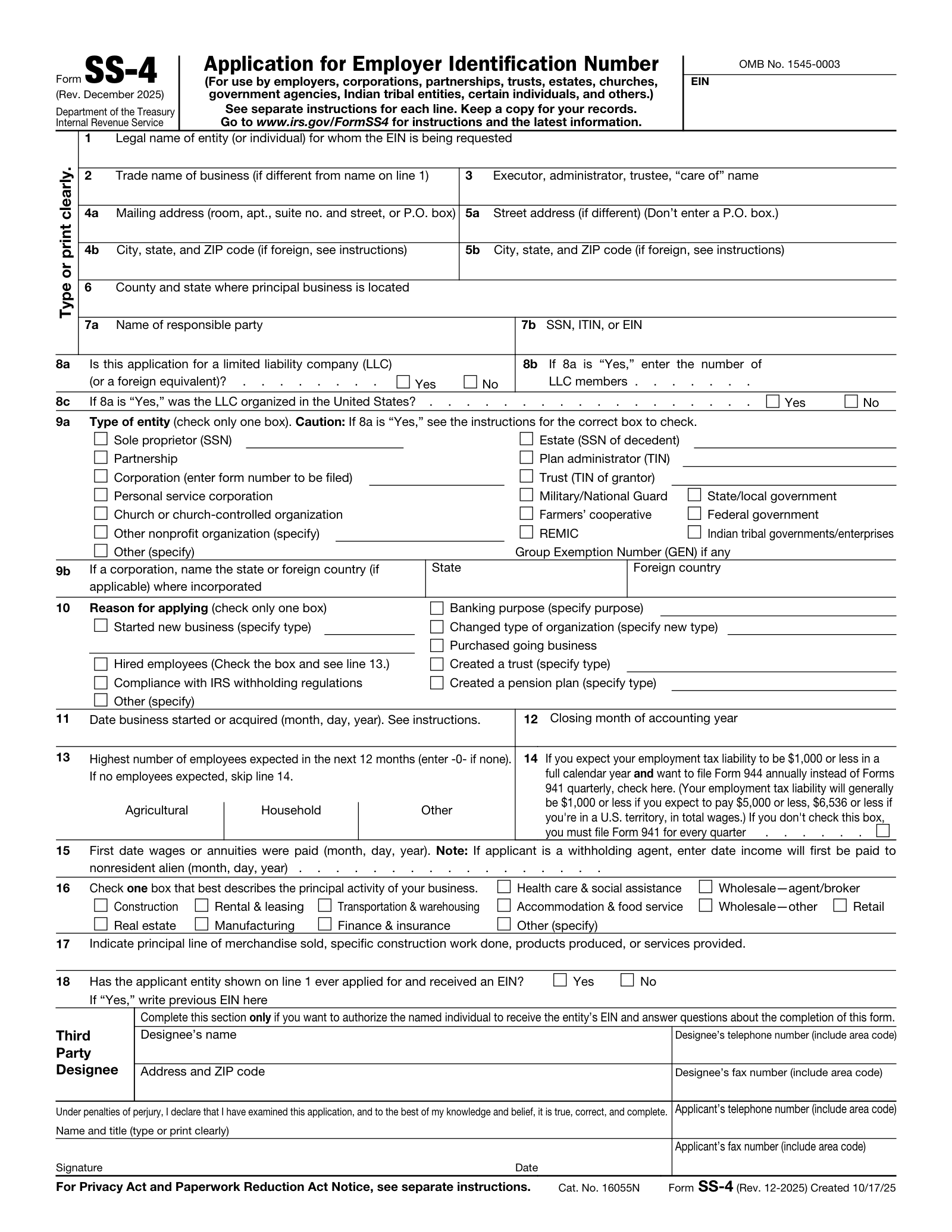
Official form (IRS.gov): Form SS-4 official PDF
The online EIN application is fast and free, but it is built for applicants with a valid SSN or ITIN. Non-residents without either number use the paper form and submit it by fax or mail. Stripe's own resource page confirms nonresidents can obtain an EIN while living outside the US without an SSN or ITIN [5].
The mechanics:
- Complete Form SS-4. Leave the SSN/ITIN field blank if you do not have one. The responsible party (the person who controls the entity) can be a non-resident individual.
- Fax the form to the IRS international line. Fax is faster than mail and the IRS can return the EIN by fax.
- Wait for the fax or letter with your EIN. Timelines vary with IRS workload;
Tip: write your fax number clearly on the form. A wrong digit means the EIN goes nowhere and you restart the clock.
How to apply for an ITIN as a non-resident
You apply for an ITIN with Form W-7, the Application for IRS Individual Taxpayer Identification Number, plus supporting identification documents. There are three submission routes: mail, in person at an IRS Taxpayer Assistance Center, or through a Certifying Acceptance Agent (CAA), a professional authorized to verify your documents so you do not mail originals [3].
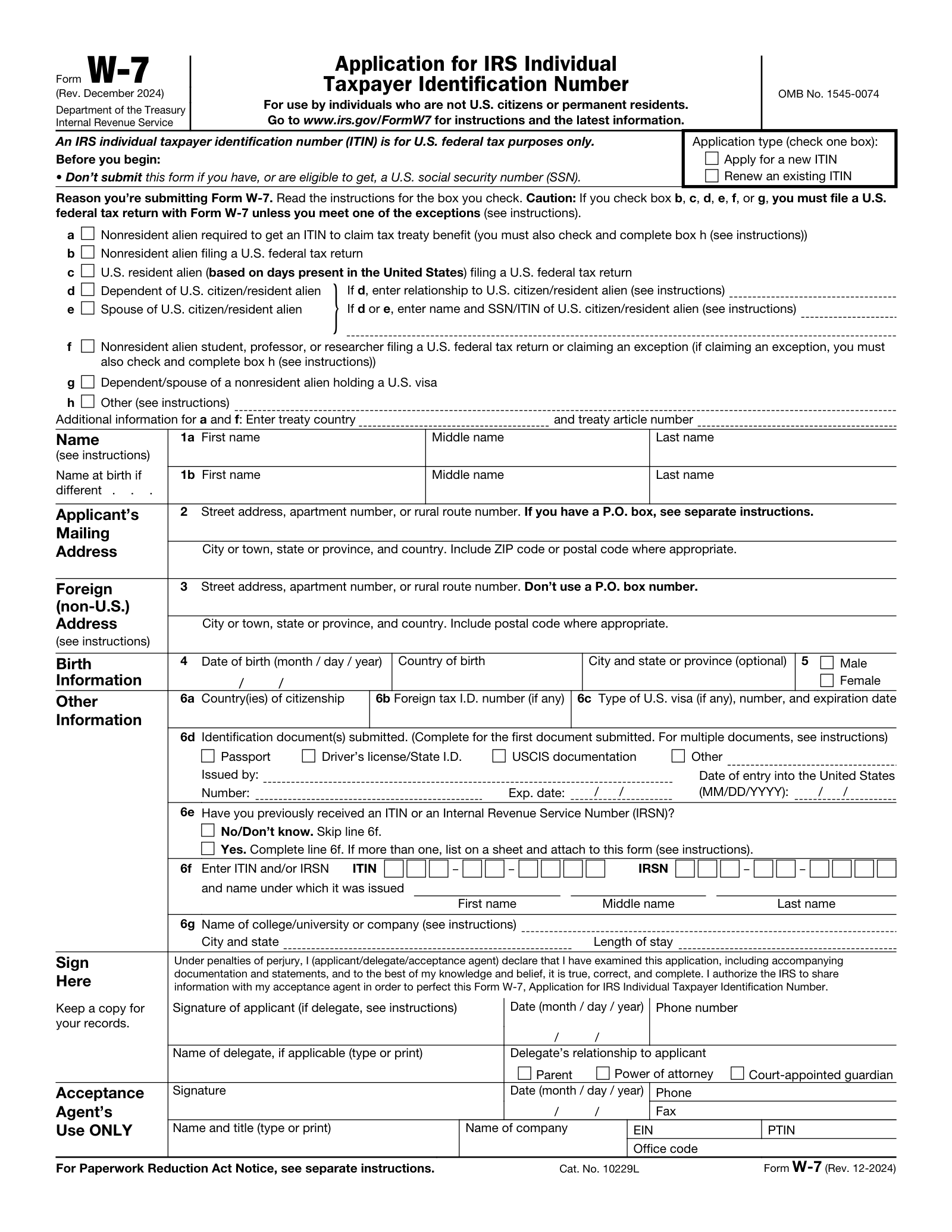
Official form (IRS.gov): Form W-7 official PDF
The document requirement is the part people underestimate. The IRS wants original documents or certified copies, and it returns originals after processing. If you mail your passport from India to the US, you are without a passport for weeks or months. That is the practical reason most non-residents use a CAA.
Suppose you are a founder in Bengaluru who needs an ITIN because you are filing a personal return to claim withheld tax. You fill out W-7, attach your passport, and mail it. Your passport sits in an IRS mailroom. If you have travel booked, you have a problem. The CAA route exists precisely to avoid that.
Heads-up: the IRS controls processing time, not your agent. A CAA verifies documents faster; it does not speed up the IRS queue. Plan for weeks, not days, and build the timeline around your filing deadline
For the application itself, how to apply for an ITIN walks through Form W-7 and the document checklist.
Common mistakes when applying for a tax ID
Most delays come from four specific errors, not from the IRS being slow.
Applying for an ITIN when only an EIN is needed. If you own an LLC and have no personal US filing requirement, you do not need an ITIN yet. Applying anyway wastes months and documents.
Assuming you need an SSN to get an EIN. You do not. The SS-4 route exists for exactly this case. Founders who believe otherwise stall for weeks trying to solve a problem that is not real.
Sending original documents without tracking. If your passport goes missing in the mail, replacing it is your problem, not the IRS's. Use tracked mail or a CAA.
Using a foreign TIN where a US TIN is required. Your PAN or Aadhaar-linked tax number is a foreign TIN. It belongs on Form W-8BEN for treaty benefits, not as a substitute for an EIN or ITIN on a US return. The two are different fields on different forms.
One more: name mismatches. The name on your SS-4, your LLC's Articles of Organization, and your bank application must match. A middle name dropped in one place and present in another triggers a rejection that costs you a week.
Do you need a tax ID to open a US bank account?
Yes. Most US banks require an EIN to open a business account, and fintechs like Mercury and Wise ask for it during onboarding. Banks operate under KYC and anti-money-laundering rules and must identify both the business and its owners.
An ITIN for the individual signer is a different question. Some banks ask for it; many accept a passport and proof of address instead. Policies vary by institution, and approval is always the bank's decision. Do not assume an ITIN guarantees an account, and do not assume you need one to apply.
If you are comparing routes, opening a US business bank account covers the online and fintech path, and in-person US bank account help covers the branch route.
How NexFyla can help with EIN and ITIN applications
NexFyla helps non-US founders form US companies and set up EIN and US business banking support. That includes preparing and submitting Form SS-4, reviewing W-7 documentation, and coordinating with a Certifying Acceptance Agent where one is needed.
We do not guarantee approval. The IRS decides, and processing time is theirs. What we do is reduce the errors that cause rejections: wrong form, blank fields that should be filled, name mismatches, missing documents.
If you are unsure whether you need an EIN, an ITIN, or both, that is the first question to settle. It depends on your entity structure and what income you actually have. Federal tax support for Form 5472 and Form 1120 covers the filing side once the numbers are in place.
Frequently Asked Questions
Can I get an EIN without an SSN or ITIN? Yes. File Form SS-4 by fax or mail. The online application requires an SSN or ITIN, but non-residents use the paper form.
Do I need an ITIN to open a US bank account? Not always. Most banks require an EIN for the business. An ITIN for the signer may be requested but is not universally mandatory. Policies vary.
How long does it take to get an ITIN? Processing takes weeks to months. A Certifying Acceptance Agent speeds up document verification, not IRS processing.
Can I use my foreign tax ID instead of an ITIN? No. A foreign TIN is for your home country. US filings require a US TIN, either an EIN or an ITIN.
Does an ITIN allow me to work in the US? No. An ITIN is a tax processing number. It does not authorize work or provide immigration status.
What is the difference between an EIN and a TIN? A TIN is the umbrella term. An EIN is a TIN for businesses; an ITIN is a TIN for individuals.
*Last updated: February 2026.*