Table of Contents
▼
What is the actual difference between an EIN and an ITIN?
An EIN identifies your business. An ITIN identifies you, personally, when you have a US tax filing obligation but cannot get a Social Security number. That is the whole rule. Everything else follows from it.
Both are TINs. A Taxpayer Identification Number is the umbrella term the IRS uses for any number it or the Social Security Administration issues to administer tax law [1]. Under that umbrella sit the SSN, the EIN and the ITIN. Same family. Different owners.
Here is the split, side by side:
| EIN | ITIN | |
|---|---|---|
| Belongs to | A business entity (LLC, corporation, partnership) | An individual person |
| Issued by | IRS | IRS |
| Application form | Form SS-4 | Form W-7 |
| Format | 9 digits, usually XX-XXXXXXX | 9 digits, starts with 9 |
| Needed when | Your entity has US filing or reporting duties | You personally file a US return or claim a treaty benefit |
| Cost from the IRS | $0 | $0 |
The conflation is the single most common mistake I see. Founders apply for an ITIN because a blog told them they need a "US tax ID," then discover their LLC still has no EIN and no way to file. Or they get an EIN and assume it covers their personal return. It does not. One number per taxpayer, and your LLC is a separate taxpayer from you.
Which tax ID does your LLC or corporation actually need?
The company needs an EIN. Always. Even a single-member LLC with no US employees, no US office and no US bank account.
The reason is not employees. It is paperwork. A foreign-owned single-member LLC treated as a disregarded entity still has to file Form 5472 each year, attached to a pro forma Form 1120. That form reports transactions between the LLC and its foreign owner, and it needs the entity's EIN to be filed at all. Skip it and the penalty is real money.
There is a second reason. Anyone who pays your LLC, or opens an account for it, asks for a W-8BEN-E, the withholding certificate for foreign entities. That form wants the entity's EIN. No EIN, no form, no payment.
Suppose you form a Wyoming LLC in January and take your first US client in March. The client's AP team asks for a W-8BEN-E before releasing payment. You cannot complete it without an EIN, so the invoice sits unpaid until the IRS mails your number. Get the EIN before you go looking for customers.
| Entity type | Entity needs | Owner may separately need |
|---|---|---|
| Single-member LLC (foreign owner, disregarded) | EIN | ITIN only if personally filing |
| Multi-member LLC | EIN | ITIN if the owner is a partner with a personal filing duty |
| C-corporation | EIN | ITIN only if personally filing |
| Your personal tax return | Nothing | ITIN (or SSN) |
One line on Form SS-4 stops people cold: the Responsible Party. That is the human being who controls the entity, and a foreign individual with no SSN and no ITIN can be listed there. You do not need an ITIN to get an EIN. If you want the entity side handled end to end, US LLC formation for non-residents covers the formation and the SS-4 together.
When does an individual non-resident need an ITIN instead?
Only when you personally have a US federal tax filing or reporting obligation and you are not eligible for an SSN. The IRS issues an ITIN to people filing a US return who are not US citizens and do not have, or cannot get, a Social Security number [3].
The triggers are specific:
- You file a US federal return, for any reason.
- You are claimed as a dependent on someone else's US return.
- You need to claim a treaty benefit on your own behalf.
- You receive US-source income that gets reported on your personal return, such as royalties or interest.
- You are a partner or member with a personal filing requirement flowing through to you.
- You are filing to claim a refund of US tax withheld.
Now the other column. Owning a foreign-owned LLC that files its own returns does not require an ITIN. Opening a US business bank account does not require an ITIN. Getting paid by US customers through your LLC does not require an ITIN. In each case the EIN plus a W-8BEN-E does the work.
An ITIN is for tax administration. It does not change your immigration status, does not authorize you to work in the US, and does not make you a resident for tax purposes [2].
How do you apply for an EIN as a foreign person?
File Form SS-4 by fax, phone or mail. The online EIN assistant requires an SSN or ITIN, so most non-residents cannot use it [5][6].
The IRS issues EINs free, directly, and the online route is instant for people who qualify [4]. You probably do not qualify. Plan for the paper routes.
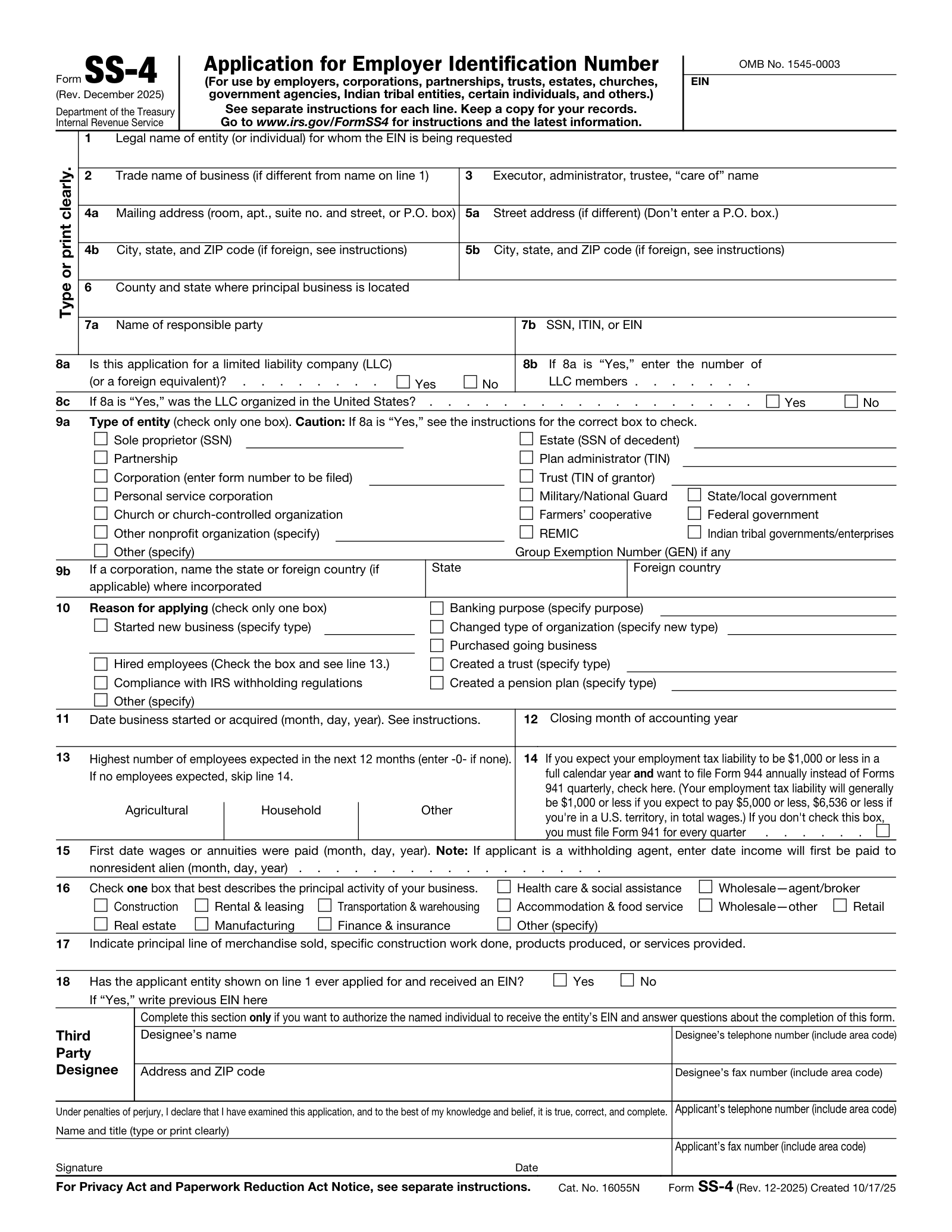
Official form (IRS.gov): Form SS-4 official PDF
Fields that trip people up:
- Line 7a, Responsible Party. Your full legal name exactly as it appears on your passport. No nominee games, no friend's name.
- Line 8a, entity type. Check the box that matches what you actually formed, not what you wish you had formed.
- Line 9, reason for applying. "Started new business" is the usual answer for a fresh LLC.
- Line 7b, SSN/ITIN. Leave it blank if you have neither. The IRS accepts a foreign responsible party without one.
- Third Party Designee. Skip it unless someone is actually handling the filing for you.
Phone is fastest for most international applicants. The IRS publishes a dedicated international applicant line, and you should pull the current number from IRS.gov rather than from any blog, including this one Fax is next. Mail is slowest and the only route that gives you a written trail by default.
Heads-up: the IRS charges nothing for an EIN. If a site quotes you a fee for "the EIN application," you are looking at a service fee, not a government fee. Pay it if you want someone else to sit on hold. Do not confuse it with tax.
How does the ITIN application work from abroad?
File Form W-7 by mail with a valid federal tax return attached, plus original documents or certified copies from the issuing agency. The IRS is explicit that mailed W-7 applications from abroad must carry original documents or certified copies, not photocopies [8].
There are three routes [3]:
- Mail. Form W-7, your federal return, and your passport or other identity documents. Original or agency-certified. The IRS returns originals, but you are without your passport for weeks.
- Certifying Acceptance Agent. A CAA verifies your documents and sends certified copies, so you keep your passport. The IRS does not charge for this. The CAA charges you a service fee.
- IRS Taxpayer Assistance Center. In person, in the US. Not practical from India unless you happen to be traveling.
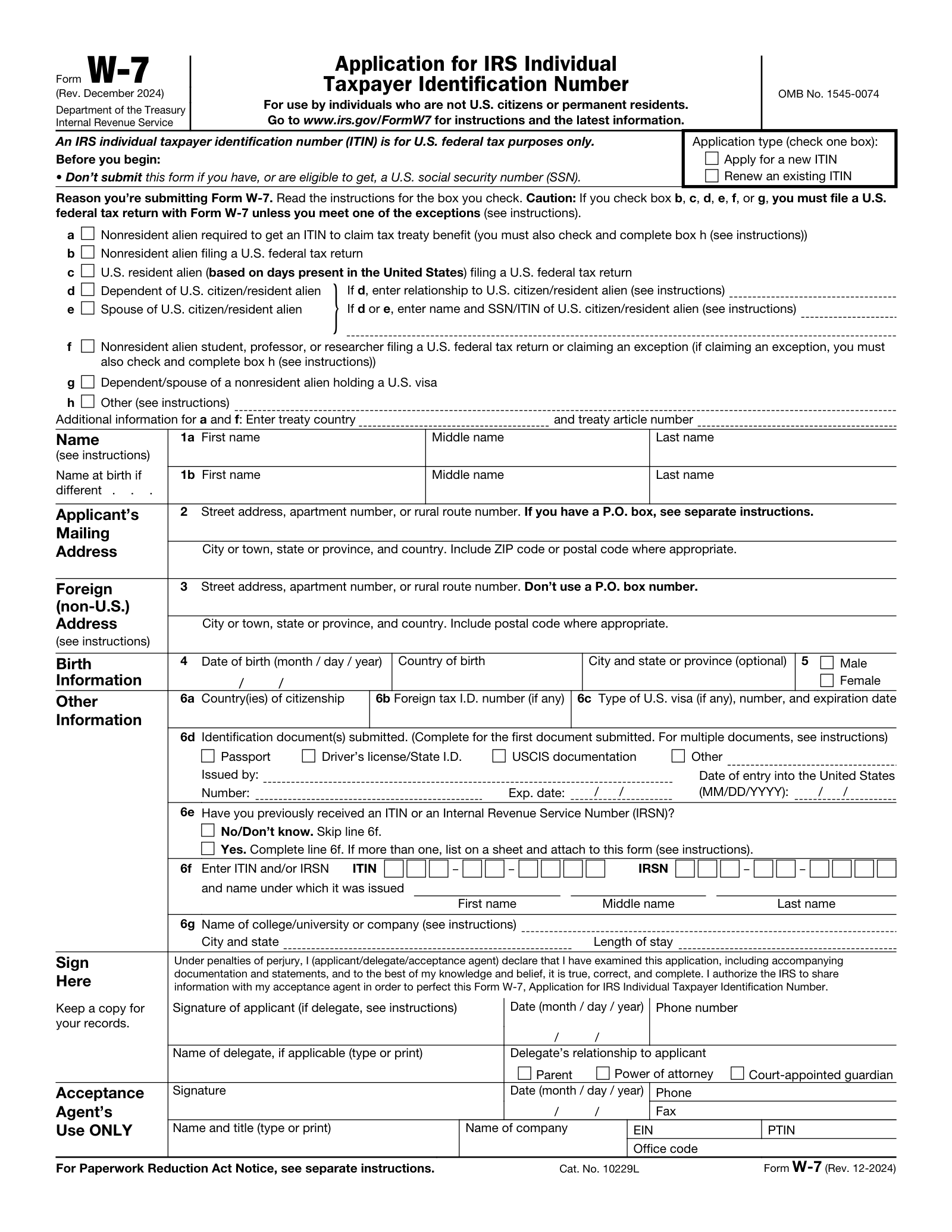
Official form (IRS.gov): Form W-7 official PDF
Processing takes weeks, not days, and it runs from the date the IRS receives a complete application.
Imagine you file your first US return in March and mail your passport with the W-7. The return is due 15 April. If the package is incomplete, the IRS sends it back and you have lost weeks. Use a CAA if you need your passport for travel in that window.
The renewal rule catches people who stop filing. An ITIN that goes unused on a federal return for three consecutive years expires and must be renewed [2]. If you got an ITIN in 2022, skipped 2023 through 2025, and now need to file, check its status before you assume it works.
Do you need both, and in what order should you apply?
Most foreign founders need only the EIN. Get the EIN first, and add an ITIN only when a personal US filing obligation appears.
The sequence:
- Form the entity.
- File Form SS-4 for the EIN.
- Open banking and payments using the EIN and a W-8BEN-E.
- Assess whether you personally have a US filing duty.
- File Form W-7 only if step 4 says yes.
An ITIN can go on Form SS-4 as the responsible party's ID if you already hold one. It is not required to get an EIN, and getting the EIN first does not block an ITIN later. The two numbers do not substitute for each other: an EIN will not work on your personal 1040-NR, and an ITIN will not satisfy your LLC's Form 5472 obligation.
Say your LLC starts paying you US-source royalties in 2026. That is the moment to look at a W-7, because withholding applies and a treaty claim needs your ITIN on the form. Until then, the EIN was enough.
For the banking step, opening a US business bank account walks through what providers ask for and why the EIN is the first thing they request.
What each ID does and does not authorize
Neither number grants immigration status, work authorization or a bank account. They are tax identifiers.
An EIN lets your business file returns, set up payroll if you hire, and complete counterparty forms. US payers ask for a W-9, which needs the EIN. Foreign entities receiving US-source income complete a W-8BEN-E, which also needs the EIN. An EIN does not make your company US-resident for tax purposes and creates no visa path.
An ITIN lets you file a personal US return and claim treaty benefits. It does not authorize work, does not make you eligible for an SSN, and does not establish US residency [2].
The W-8BEN versus W-8BEN-E split follows the same logic. Individuals file W-8BEN. Entities file W-8BEN-E. Get the wrong one and the payer rejects it.
Common Mistakes
Most delays come from applying for the wrong number, missing documents or mismatched names. Not from IRS backlogs.
- Applying for an ITIN when only the company needed an EIN. The fix: check whether you personally have a filing duty. If not, you need the SS-4, not the W-7.
- Leaving the Responsible Party blank or inserting a nominee. The IRS wants the human who controls the entity. A foreign person with no SSN or ITIN is fine there.
- Mailing photocopies with Form W-7. The IRS requires originals or certified copies from the issuing agency when you apply from abroad [8]. Photocopies get the package returned.
- Name mismatch between Form SS-4 and the formation documents. Use the exact legal name on your Articles of Organization. One missing word and the IRS asks questions.
- Assuming the online EIN tool works without an SSN or ITIN. It does not. Use fax, phone or mail [5].
- Reusing one EIN across two entities. Each legal entity gets its own. A second LLC needs a second SS-4.
- Paying a third party for something the IRS does free. The EIN and the W-7 cost nothing from the IRS. Agent and CAA fees are service fees.
If your SS-4 keeps bouncing, getting an EIN as a non-US resident covers the filing mechanics line by line. And if the ITIN is genuinely the one you need, applying for an ITIN with Form W-7 handles the document certification question.
Frequently Asked Questions
Can I use my ITIN to get an EIN? Yes. An ITIN can go on Form SS-4 as the responsible party's ID. It is not required. A foreign responsible party with neither an SSN nor an ITIN can still apply.
Does my foreign-owned LLC need an ITIN for its owner? No. The LLC needs an EIN. The owner needs an ITIN only if they personally have a US filing or reporting obligation.
Is there a fee to get an EIN or ITIN? The IRS charges nothing for either. Any charge you see is a provider, agent or Certifying Acceptance Agent service fee.
Can I apply for an EIN online from outside the US? Generally no. The online assistant requires an SSN or ITIN. Foreign applicants use fax, phone or mail with Form SS-4.
Does an ITIN expire? Yes. An ITIN not used on a federal return for three consecutive years expires and must be renewed.
Does an EIN let me work in the US or get a visa? No. An EIN is a tax ID for the business. It grants no immigration status and no work authorization.
The short version
Get the EIN. That is the number your LLC needs, and it is free, and you can apply without an SSN or ITIN. Add the ITIN later, and only when a personal US filing obligation actually exists. If you are unsure which one your situation calls for, ask a qualified tax professional before you mail a passport to the IRS.
NexFyla helps non-US founders form US companies and set up EIN and US business banking support. If you want help with US LLC formation, EIN and business setup, NexFyla can assist.
*Last updated: February 2026.*