Table of Contents
▼
What is an EIN, and why does your US LLC need one before anything else?
An EIN is a nine-digit federal tax ID number the IRS issues to a business, and it is free. You need it before a US bank will open an account for your LLC, before Stripe or any payment processor will verify you, and before you file a single federal return. [2]
Quick Answer: An EIN (Employer Identification Number) is the IRS's federal tax ID for your US LLC. The IRS issues it free. Non-residents can get one without an SSN or ITIN by filing Form SS-4 by fax or mail. Your LLC needs the EIN to open a US business bank account, accept card payments, and file federal tax returns.
Four acronyms get mixed up constantly. Here is the split:
- SSN: a Social Security number, for individuals authorized to work in the US. You probably do not have one.
- ITIN: an Individual Taxpayer Identification Number, also for individuals, issued to people who file US taxes but cannot get an SSN.
- TIN: the umbrella term. An SSN, an ITIN and an EIN are all TINs.
- EIN: the business version. It belongs to the entity, not to you.
That last point matters more than it looks. Your LLC is a separate taxpayer in the eyes of the IRS even when it is a single-member disregarded entity. The EIN is how the IRS tracks that entity. Your personal tax ID, if you ever get one, is a different number for a different purpose.
One more split that trips up first-time founders: the state registers your LLC, the IRS issues your EIN. Wyoming or Delaware or New Mexico gives you a filing stamp and an entity number. None of those is a tax ID. You still have to apply to the IRS separately, and that application is the part people get wrong.
If you have not formed the entity yet, start with US LLC formation for non-residents and come back here once your Articles of Organization are approved. The IRS wants your legal name to match state records exactly, and you cannot match what does not exist.
Can you apply for an EIN without an SSN or ITIN?
Yes. The IRS issues EINs to entities whose owner has no SSN and no ITIN. The online EIN assistant is the problem, not the rule.
The online assistant validates the responsible party against SSN or ITIN records. No match, no submission. That is why almost every foreign founder ends up on paper: Form SS-4, faxed or mailed. [4]
So who is the responsible party? The individual who ultimately owns or controls the entity. For a single-member LLC, that is you. The SS-4 asks for that person's SSN or ITIN, and the honest answer for a foreign founder is that you do not have one. You write that on the form rather than leaving the line empty. More on the exact wording below.
The phone option exists, and it is genuinely the fastest route when it works. It does not work for most non-residents. The IRS phone line expects the caller to identify themselves with an SSN or ITIN. If you have neither, you are back to paper.
Say your LLC is formed in Wyoming in March and you want a Mercury account by May. You cannot start with the bank. You start with the SS-4, because the bank's onboarding form has a required EIN field and no workaround. Plan the EIN as week one, not week six.
There is a persistent myth that a formation service can somehow push you through the online portal. It cannot. The portal checks a database. Nobody bypasses a database check. Anyone promising an instant online EIN for a founder with no SSN is describing a service that files the SS-4 for you, which you can do yourself for free.
Form SS-4 line by line for a foreign applicant
Fill every line that applies, write "N/A" where a US-only field does not, and never leave the responsible party section unexplained. The SS-4 is a short form. Precision, not length, is what gets it approved. [4]
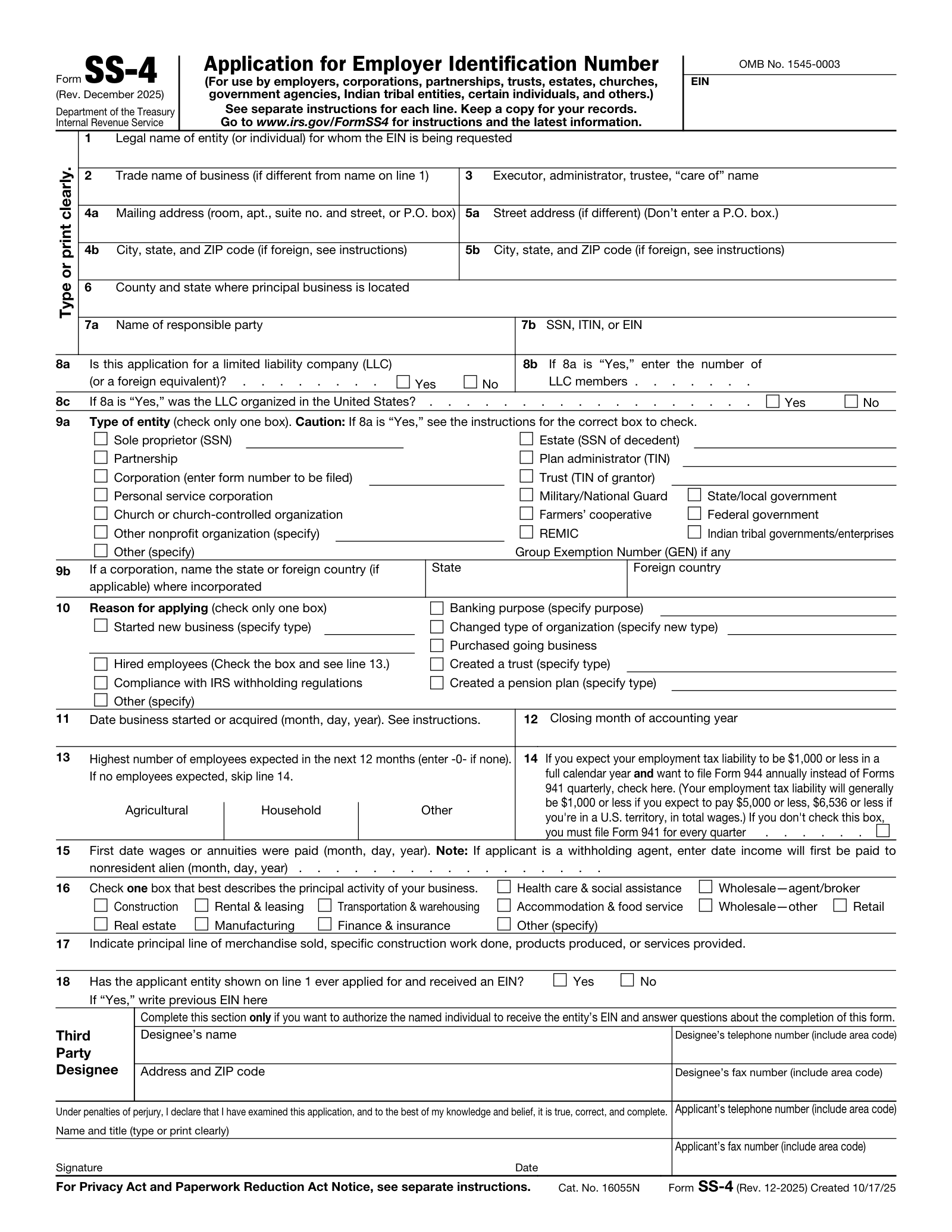
Official form (IRS.gov): Form SS-4 official PDF
Here is the field map. The right-hand column is where non-resident applications actually fail.
| SS-4 field | Typical US applicant | What a non-resident writes | Why it matters |
|---|---|---|---|
| Line 1 legal name | LLC name | Exact name on your Articles of Organization, including "LLC" | A mismatch with state records is the single most common rejection |
| Line 2 trade name | DBA if any | Leave blank unless you registered a DBA | Inventing a brand name here creates confusion |
| Line 3 executor | Usually blank | Blank | Not applicable to most founders |
| Line 4 mailing address | US address | Your home address abroad is acceptable | The IRS mails the CP 575 here, so it must be reliable |
| Line 5 street address | US street address | Registered agent address or your foreign address | Do not use a PO box on line 5 |
| Line 7a-7b responsible party | Name plus SSN | Your full name; see the note below on the SSN/ITIN line | This is the line the IRS scrutinizes hardest |
| Line 8 entity type | Check the box | LLC box, then number of members | Wrong box changes your filing obligations later |
| Line 9 reason for applying | Started new business | "Started new business" or "Banking purpose" | Banking purpose is legitimate and common for foreign-owned LLCs |
| Line 10 date started | Formation date | Your LLC formation date | Blank here delays processing |
| Line 11 date closed | Blank | N/A | Only for entities closing |
| Line 12 closing month | December | December, unless you have a reason | Sets your tax year |
| Line 13 employees | 0 or a number | 0 for most founders | Answer honestly; it drives payroll obligations |
| Line 14-15 prior EIN and prior business | Usually no | No | Only yes if you have genuinely had one |
| Line 16 principal activity | Consulting, retail, etc. | Your real activity | Vague answers invite questions |
| Line 17 description | One line | One line, specific | Same |
| Line 18 prior EIN for this entity | No | No | Do not confuse with line 14 |
On the responsible party's SSN/ITIN line: the SS-4 instructions cover foreign responsible parties, and the current wording is worth reading yourself rather than trusting a blog. Write "Foreign" or "N/A" as the instructions direct, and never leave it blank with no explanation.
Lines 18a to 18c are the third-party designee block. If you want your accountant or a service to speak to the IRS about this application, that is where you authorize it. Do not put their name on line 7 instead. That is a different thing entirely, and it is the next section.
What if the IRS asks for a responsible party who is not you?
The responsible party should be you, the actual owner. If you list a registered agent or a formation service there, the IRS can question it, and you have created a problem for no benefit.
Why do people do it? Usually because the service filled the form. A registered agent is the company that receives legal mail on your LLC's behalf. They are not the owner. Listing them as responsible party misstates who controls the entity, and the IRS notices mismatches like that.
Suppose you used a provider that offers to file the SS-4 for you. Ask to see the completed form before it goes out. Check line 7. If it has the provider's name, stop and fix it. You are the owner; the form should say so.
The correct way to let someone else deal with the IRS on your behalf is the third-party designee block on the SS-4 itself, or a separate authorization. Form 2848 is a power of attorney for tax matters. Form 8821 authorizes someone to receive your tax information. Both are formal, both are separate from the SS-4, and both are things you file when there is a real need, not by default.
My call: put yourself on line 7, every time. If you want your CPA copied on IRS correspondence, use the designee block. Skip the arrangement where a provider's name appears as owner. It saves nothing and costs you a correction later.
How should a non-resident submit Form SS-4: fax, mail, or phone?
Fax. For a non-resident, fax is the practical default: fastest paper route, international-friendly, and you get a transmission receipt as proof of filing.
| Channel | Who can use it | Typical speed | How you do it | Caveats |
|---|---|---|---|---|
| Fax | Anyone, including foreign applicants | Days to a couple of weeks | Send to the IRS fax number for your state or for international applicants | Keep the confirmation page |
| Anyone | Several weeks | Post to the IRS address for your state; certified mail recommended | Slower, and harder to prove delivery | |
| Phone | Callers with an SSN or ITIN | Same call | IRS Business & Specialty Tax Line | Not available to most foreign founders |
| Provider or CPA filing | Anyone, paid | Depends on the provider | They prepare and send the SS-4 | A service fee, not a government fee |
The government fee for an EIN is zero. The IRS issues EINs free. [2] Any money you pay goes to a provider, an agent or a CPA for their time. Keep those two numbers separate in your head when you compare options.
For the fax route: print the completed SS-4, sign it, add a short cover sheet with your name, your LLC name, your return fax number and your email, then send it to the correct IRS fax number. International fax numbers change, so check irs.gov the week you file rather than trusting a screenshot.
For mail: same form, same signature, sent to the IRS address for your state or the international address. Use tracked post. If the letter vanishes, you want a record.
A faxed signature is accepted. You do not need to courier an ink original.
How long does the EIN take, and how do you check status?
Fax runs days to a couple of weeks. Mail runs several weeks. Phone is immediate when you qualify, which most non-residents do not. Those are ranges, not commitments, and IRS backlogs move them.
When the EIN is assigned, the IRS sends a CP 575, the original notice with your number on it. Keep it. Banks and payment processors ask for it, and some ask for it months after onboarding.
If you lose the CP 575, you request a 147C letter, which is the replacement confirmation of your EIN. Same number, different document. You will need it if a bank rejects a scanned CP 575 or asks for a fresh letter with a recent date.
To check status, call the IRS Business & Specialty Tax Line and have your LLC name, your name, your formation date and your fax confirmation date ready.
Imagine six weeks pass with no CP 575. Do not file a second SS-4 with a different name variant, because that creates duplicate-entity confusion. Call first. If the line confirms nothing was received, refax the same form with a cover note saying "second submission, original sent on [date]."
Common Mistakes
Most rejections come from four things: blank required lines, a legal name that does not match state records, the wrong entity type box, or an incomplete responsible party section. All four are fixable before you fax.
| Mistake | Why it triggers a rejection or delay | The fix |
|---|---|---|
| Legal name differs from the Articles of Organization | The IRS cannot match the entity to state records | Copy the state filing exactly, including "LLC" |
| Responsible party SSN/ITIN line left blank | Incomplete application | Write what the instructions require for a foreign responsible party, not nothing |
| Registered agent listed as responsible party | Misstates who owns the entity | Put your own name on line 7 |
| Wrong reason for applying | Inconsistent with your activity | "Started new business" or "Banking purpose" |
| Missing date started on line 10 | Incomplete | Use your formation date |
| No signature | The form is not valid | Sign it; a faxed signature is fine |
| Illegible fax | Data entry errors downstream | Send a clean print, not a photo of a print |
Heads-up on timelines: an SS-4 rejection usually comes back as a returned form or a letter, not a phone call. If you move house and forget to update the mailing address on line 4, you may never see the notice and you will assume silence means processing.
If your application does come back, the IRS normally tells you which line is the problem. Fix that line, refax, and keep the second confirmation. Do not rewrite the whole form from scratch; a fresh version invites fresh errors.
What should you do with the EIN once it arrives?
Store the CP 575 as a PDF and in a folder you will still have in three years, then use the EIN for three things: a US business bank account, payment processing, and federal filings.
Start with banking. A US business bank account is what turns an LLC from a registration into an operating company. Fintech options and brick-and-mortar banks both ask for the EIN, your formation documents and ID. An LLC makes you eligible to apply; approval stays the provider's decision, and no honest service can promise it. If you want the online route, see opening a US business bank account as a non-resident. If you would rather walk into a branch, the in-person path is covered separately.
Then payments. Stripe and similar processors verify your business against the EIN and your ownership details. Same rule: eligibility, not a guarantee.
Then taxes, which is where foreign-owned LLCs get surprised. A single-member LLC owned by a non-resident is by default a disregarded entity, but it still has an annual federal filing obligation: Form 5472 attached to a pro forma Form 1120. Miss it and the penalty is severe. This is not optional paperwork you can skip because the LLC made no US-source income.
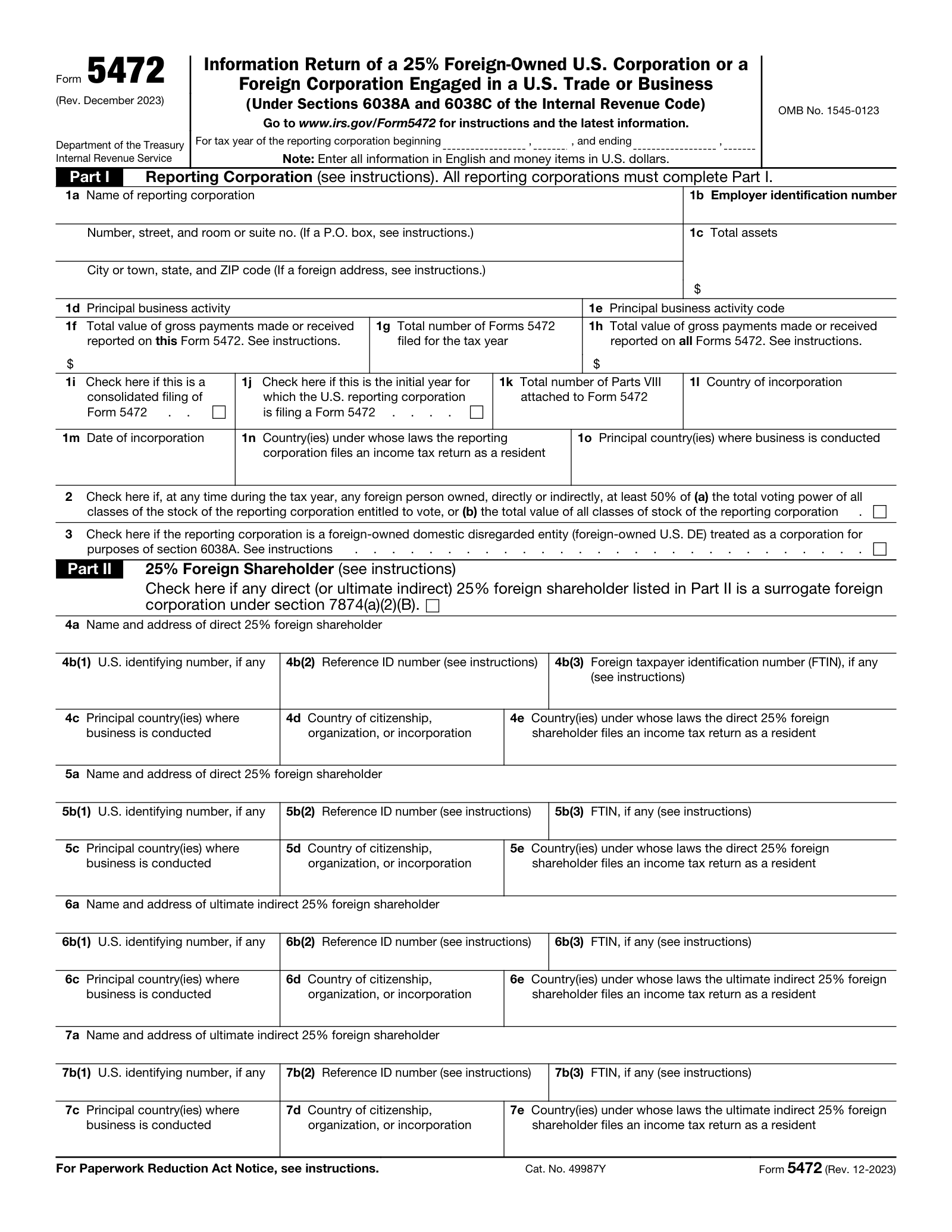
Official form (IRS.gov): Form 5472 official PDF
When a US payer asks you for a W-8BEN-E, that is the entity-level withholding certificate, and it is separate from both the EIN and Form 5472. Do not confuse the three.
State obligations run on their own track. Annual reports and state fees have nothing to do with your EIN, and paying one does not cover the other.
If you want the filing side handled, federal tax support for Form 5472 and Form 1120 exists for exactly this. And if you still need the number itself, getting an EIN as a non-US resident is the step before all of this.
Frequently Asked Questions
Can I get an EIN without an SSN or ITIN? Yes. The IRS issues EINs to entities whose responsible party has neither. You apply on Form SS-4 by fax or mail because the online assistant validates SSN and ITIN records.
What do I write on the SS-4 line for the responsible party's SSN? Enter your full name on line 7a. For the SSN/ITIN entry, follow the current SS-4 instructions for foreign responsible parties and do not leave the section blank without explanation. Read the instructions on irs.gov the week you file.
Is the online EIN application available to non-residents? No, for most. The online assistant requires an SSN or ITIN. Without one, you use Form SS-4.
How long does an EIN take for a non-resident? Fax is usually days to a couple of weeks. Mail can take several weeks. Phone is same-day but requires an SSN or ITIN. Verify current IRS processing times before you plan around them.
Does it cost anything to get an EIN? The IRS issues EINs free. Any charge comes from a provider, agent or CPA helping you prepare or send the form.
What if my SS-4 is rejected? The IRS normally returns it with the reason. Fix the flagged line, usually a blank field, a name mismatch or the responsible party section, then refax or remail and keep the new confirmation.
Can I use the EIN before the CP 575 arrives? Yes, once the IRS has assigned the number. Many founders get the EIN confirmed by phone before the letter lands. Banks may still ask for the CP 575 or a 147C, so keep both routes in mind.
*Last updated: February 2026.*