Table of Contents
▼
How much does it cost to register a company in the USA in 2026?
Government filing fees run roughly $35–$500 depending on the state, and the average LLC filing fee is about $132 [8][10]. But if you live in India and you are forming your first US company, that headline number is not your bill.
Quick Answer: State filing fees for a US company range from about $35 to $500, averaging near $132. A non-US resident founder also pays a registered agent ($50–$300/year), a US business address ($10–$50/month), and often EIN or compliance help. Realistic all-in year-one cost lands between $500 and $1,500 for an LLC, and higher for a Delaware C-Corp with banking and tax support.
There are three buckets, and mixing them is why most cost articles mislead you:
- Government fees - what the state and the IRS charge. The SBA says the total cost to register a business is usually under $300, with fees varying by state and structure [3].
- Provider fees - registered agent, formation service, US address, EIN assistance. These are optional in theory, near-mandatory in practice when you have no US presence.
- Recurring fees - annual report, franchise tax, registered agent renewal, and federal compliance filings. These come back every year whether you earn revenue or not.
One more thing worth separating: "registration" means two different things. Registering with a state (your LLC or corporation) is one process. Registering with the IRS (getting an EIN) is another, and it is free. Founders who treat them as one step end up paying for something the IRS gives away.
State filing fees: what does each popular state actually charge?
Filing fees are set by each Secretary of State and range from $40 in Kentucky to $500 at the top end, with Arizona, Kentucky and Colorado coming in under $100 for the first year [1][8][12].
Here is how the states non-US founders actually pick stack up. Treat the annual column as the number that matters more than the filing fee.
| State | Entity | Filing fee | Annual fee / franchise tax | Notes for non-residents |
|---|---|---|---|---|
| Wyoming | LLC | $100 | $60 minimum annual report | Cheapest popular option; strong privacy; no state income tax |
| Delaware | LLC | $110 | $300 annual LLC tax | Popular but not cheap; the $300 recurs every year |
| Delaware | C-Corp | $89+ | Corporate franchise tax, calculated | The default for VC-backed startups; franchise tax math is different from the LLC tax |
| Colorado | LLC | $50 | Check the current official fee | One of the cheapest filings |
| Arizona | LLC | $50 | Check the current official fee | Cheap to file |
| Kentucky | LLC | $40 | Check the current official fee | Lowest filing fee of the popular set |
| New Mexico | LLC | $50 | Check the current official fee | No annual report for LLCs in many cases |
| California | LLC | $70 | $800 minimum franchise tax | The $800 is a tax, not a filing fee, and it recurs |
| Texas | LLC | $300 | Franchise tax based on revenue | Higher upfront, no annual report in the same form |
| Florida | LLC | $125 | $138.75 annual report | Annual report is due early in the year |
| New York | LLC | $200 | Publication requirement | New York adds a newspaper publication cost that varies by county |
Wyoming is the state most non-US founders land on, so the numbers deserve care. The LLC filing fee is $100, and the annual report is a $60 minimum based on assets located in Wyoming [7][9]. People quote that $60 as flat. It is a minimum, not a fixed price.
Heads-up on California: the $800 minimum franchise tax is a recurring government fee, not a one-time filing charge [1]. Founders pick California for the address and discover the $800 in year two. That single line item is larger than most founders' entire year-one budget in Wyoming.
Note: state fees change. Verify the current figure on the relevant Secretary of State site before you file, and never trust a blog table (including this one) over the official fee schedule.
What do registered agent and US business address services cost?
A registered agent costs $50–$300 per year, and a US business address (virtual mailbox) adds roughly $10–$50 per month. Non-US founders need both, because neither role can be filled from India.
A registered agent is the person or company that receives legal documents and state notices on your company's behalf. Most states require one, and it must have a physical street address in that state - a PO box does not qualify.
A US business address is separate. It is the mailing and business address your company uses on bank applications, Stripe, and contracts. A registered agent address is often not usable as your general business address, which catches people out.
Your options:
- Be your own registered agent - not possible from abroad. You need a physical US address in the state of formation, and you need to be reachable during business hours.
- Budget provider - $50–$100/year. Fine for a simple LLC with no urgent legal exposure.
- Premium provider (Northwest, Registered Agents Inc., and similar) - $100–$300/year. You are paying for faster document scanning and better support.
The trap: many formation packages include the first year of registered agent free, then auto-renew at full price. That renewal is a recurring cost you should budget from day one, not a surprise in month thirteen.
EIN, ITIN, and US banking: which costs are government vs provider?
An EIN is free from the IRS on Form SS-4. An ITIN is also free from the IRS on Form W-7, though it requires certified identity documents. Providers charge $50–$300 to help with either, because the process is slow and easy to get wrong from abroad.
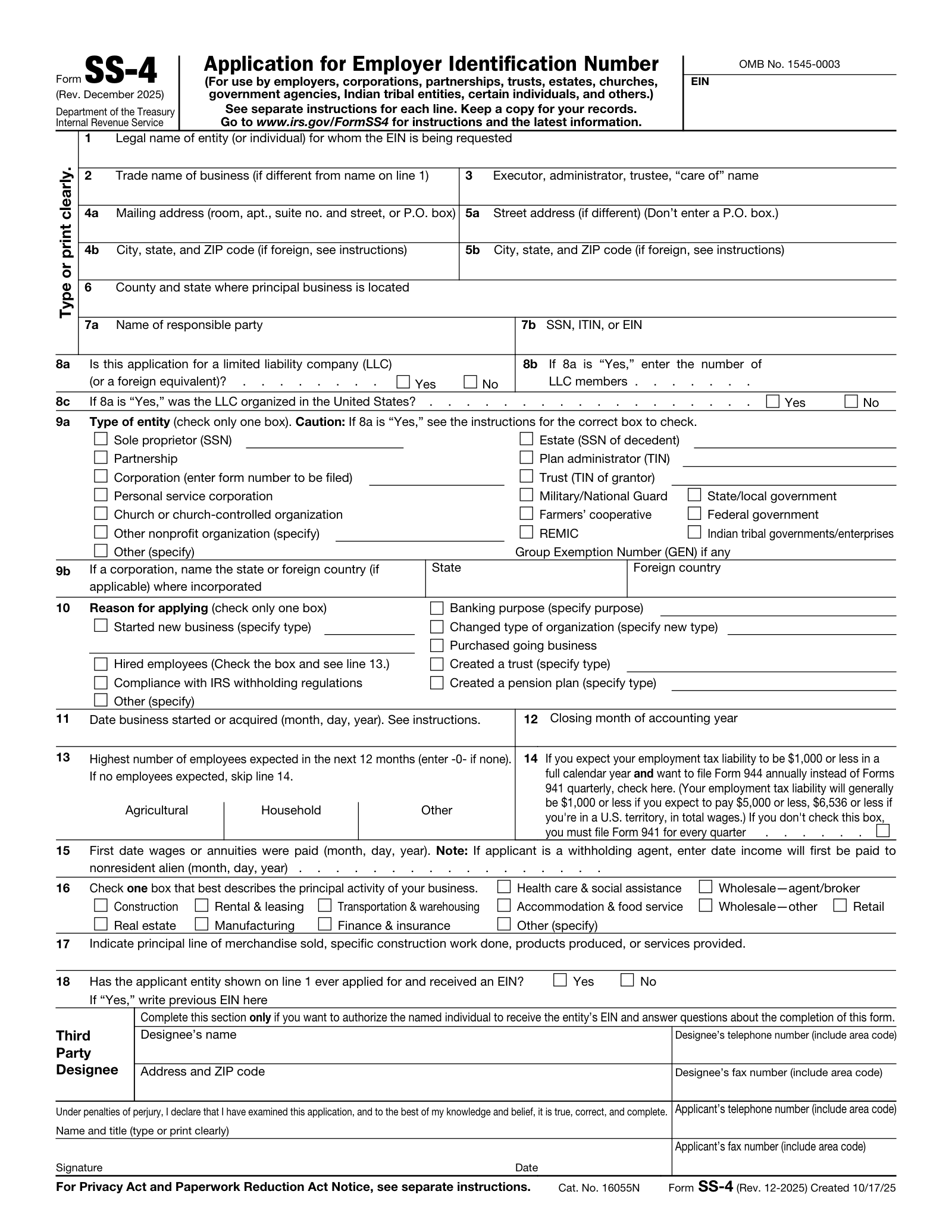
Official form (IRS.gov): Form SS-4 official PDF
The EIN and ITIN confusion costs founders real money, so here is the clean split:
- EIN - an Employer Identification Number. It belongs to your company. A non-US resident can get one without an SSN by fax or mail using Form SS-4. It is free.
- ITIN - an Individual Taxpayer Identification Number. It belongs to you as a person, and you only need one if you must file a US personal tax return and have no SSN. That is Form W-7, and it requires certified copies of your passport or similar ID.
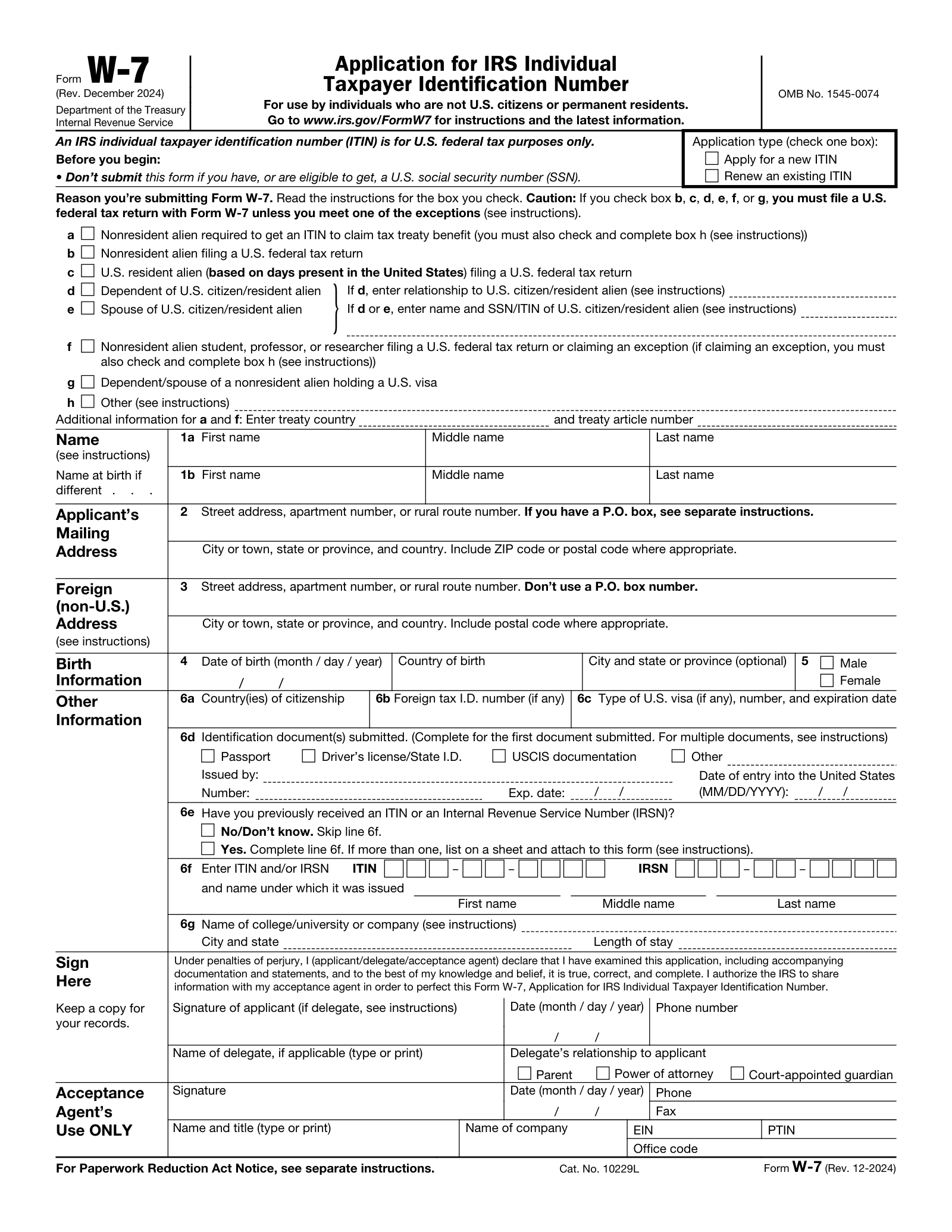
Official form (IRS.gov): Form W-7 official PDF
Most founders forming a US LLC do not need an ITIN. The company needs an EIN. Your personal filing obligation depends on your ownership, your US-source income, your treaty position and your entity classification - that is a question for a qualified tax professional, not a blog.
Banking is the other line item people forget to cost. US business bank accounts for non-residents often require an in-person visit, which means a flight. The practical alternative is a fintech provider such as Mercury, Relay or Wise Business. Mercury publishes that non-US founders can apply, and as of early 2026 its standard business account carries no monthly fee - but approval is always the provider's decision, and an LLC only makes you *eligible* to apply. Do not budget on the assumption you will be approved.
What are the ongoing annual fees and franchise taxes you must budget for?
Recurring government costs include annual reports (Wyoming $60 minimum, Florida $138.75) and franchise taxes (California $800 minimum, Delaware LLC $300). These are three different things, and readers conflate them constantly.
- Annual report - a filing that confirms your company's details are current. Wyoming's starts at $60; Florida's is $138.75.
- Franchise tax - a tax for the privilege of existing in the state. California's minimum is $800. It applies whether or not you made money.
- LLC annual fee - some states just call the annual report a fee. Functionally the same payment, different label.
Delaware deserves its own warning. The $300 annual LLC tax and the corporate franchise tax are not the same calculation. If you form a Delaware LLC, you pay the $300. If you form a Delaware C-Corp, your franchise tax is calculated on a different basis entirely. Founders who read a C-Corp article and form an LLC get this wrong.
Then there is the federal layer that almost no cost guide mentions. A foreign-owned single-member LLC must file Form 5472 with a pro-forma Form 1120 every year. The penalty for not filing is $25,000
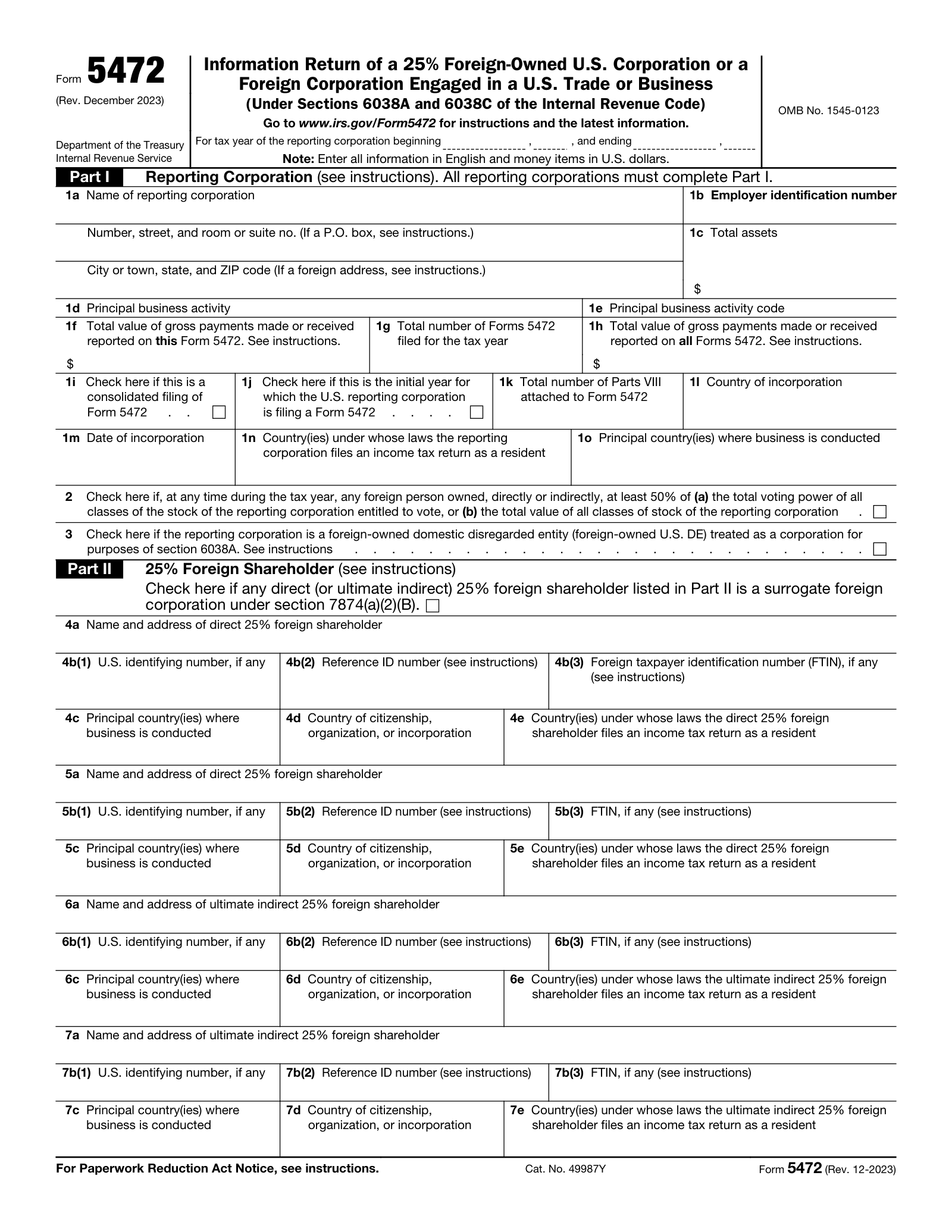
Official form (IRS.gov): Form 5472 official PDF
The form itself is free. Getting it right usually is not - most non-US founders hire a CPA, and that fee recurs annually. Budget for it as a compliance cost, not a one-off.
How much do formation service providers mark up the state fee?
Reputable providers pass the state fee through at cost and charge $0–$500 on top for the filing service, plus $100–$300/year for registered agent and $50–$200 for add-ons like EIN help and operating agreement templates.
| Provider type | Typical package price | What's included | What's extra |
|---|---|---|---|
| DIY (file yourself) | $0 service fee | You file with the state directly | Registered agent, address, EIN - all on you |
| Budget formation service | $50–$150 + state fee | Filing, sometimes first-year agent | Address, EIN help, compliance filings |
| Mid-tier service | $200–$400 + state fee | Filing, agent, template operating agreement | Address, EIN, tax filings |
| Premium all-inclusive | $500+ + state fee | Filing, agent, address, EIN, compliance alerts | CPA work, state taxes |
The markup is the service fee. If a provider quotes you a number that looks like it *includes* the state fee, check the breakdown - it should show the government fee separately.
Watch the "free LLC" offers. The filing may be free, but the registered agent renewal at $100–$300/year is where the economics live. Two years of that renewal costs more than the filing fee you saved.
Sample year-one budgets for a non-US founder (India-based)
A lean Wyoming LLC for an India-based founder lands around $500–$700 in year one. A Delaware C-Corp with banking and compliance support runs $1,500–$3,000+. Here is what each looks like itemized.
Budget Wyoming LLC
- Wyoming LLC filing fee: $100
- Registered agent (year one): $50–$100
- US business address: $120–$360 ($10–$30/month)
- EIN: $0 (free from the IRS) or $50–$150 if you pay for help
- One-time: notarization and courier, roughly $50–$150
- Total: $500–$700
- Delaware incorporation fee: $89+
- Registered agent: $100–$300
- US business address: $120–$600
- EIN: $0–$150
- Delaware franchise tax (year one): calculated, budget $400–$1,000
- CPA for corporate filings: $500–$1,500
- Total: $1,500–$3,000+
- Everything above, plus ITIN application support if needed, operating agreement drafting, and compliance monitoring. Add $300–$1,000.
Standard Delaware C-Corp
Premium all-inclusive package
One-time costs people forget: apostille or notarization of your documents (varies by country and document count) and international courier fees if anything must be physically mailed. If you do need an ITIN, the Form W-7 process requires certified ID, which usually means a trip to a notary or an acceptance agent - another small cost.
These are estimates. Verify current state fees before you commit, because a $50 swing in a filing fee is normal year to year.
Common mistakes that inflate your US company registration cost
Choosing a state for the wrong reason costs the most. Picking California for the address without knowing about the $800 minimum franchise tax turns a $500 budget into $1,300+ every year. Fix: pick the state for your business model, not the postcode.
- Assuming Delaware is always best. Delaware is the right call for VC-backed C-Corps. For a solo consultant LLC, Wyoming's $100 filing and $60 minimum annual report is usually cheaper. Fix: match the entity and state to your actual plan.
- Paying a provider for an EIN you can get free. The IRS issues EINs at no charge on Form SS-4. Fix: file it yourself by fax or mail, or pay only if the process is genuinely blocking you.
- Paying for an ITIN when you only needed an EIN. These are different forms for different people. Fix: confirm which one you actually need before spending.
- Letting a "free" registered agent auto-renew. The first year is free; the renewal is $100–$300. Fix: check the renewal price before you sign up.
- Missing the annual report deadline. Late filings carry penalties that vary by state. Fix: put the due date in your calendar the day you form the company.
- Forgetting Form 5472. A foreign-owned single-member LLC files Form 5472 with a pro-forma 1120 annually, and the penalty for not filing is $25,000 Fix: budget for a CPA from year one.
Note: tax treatment depends on your ownership, your US-source and effectively connected income, any treaty position, state nexus and your entity classification. Talk to a qualified tax professional about your situation.
Frequently Asked Questions
Can a non-US citizen register a company in the USA? Yes. Most states require no citizenship or residency to form an LLC or C-Corp. You need a registered agent and a US address, and you can get an EIN without an SSN.
How much does it cost to register an LLC in the USA in 2026? State filing fees run about $35 to $500, averaging near $132 [8]. Add a registered agent ($50–$300/year) and a US address ($10–$50/month). Year-one all-in for a non-US founder is typically $500–$1,500.
Is it cheaper to form an LLC in Wyoming or Delaware? Wyoming: $100 filing, $60 minimum annual report. Delaware: $110 filing, $300 annual LLC tax. Wyoming is usually cheaper for small non-US founders. Delaware is the standard for VC-backed C-Corps.
Do I need an ITIN to register a US company? No. The company needs an EIN, which is free on Form SS-4. An ITIN (Form W-7) is only for an individual who must file a US tax return and has no SSN.
What ongoing fees should I expect after forming a US LLC? An annual report or franchise tax (Wyoming $60 minimum; California $800 minimum), registered agent renewal ($50–$300), and possibly CPA fees for Form 5472 and pro-forma 1120 compliance.
Are there hidden costs in "free" LLC formation packages? Yes. Many include a free first-year registered agent that auto-renews at $100–$300/year, and charge extra for EIN help, operating agreements and compliance filings.
If you want help with [INTERNAL LINK: US LLC formation], [INTERNAL LINK: EIN for non-US residents] and [INTERNAL LINK: US business bank account] setup, NexFyla can assist. Start by deciding your state and entity, then build the three-bucket budget above before you pay anyone a filing fee.
*Last updated: February 2026.*
Sources
- [1] LLC Formation Costs by State: 2026 Guide - USA Corporate Services Inc. - https://www.usa-corporate.com/corporate-services/start-up-costs/
- [3] Launch your business - Small Business Administration - https://www.sba.gov/counseling/launch-your-business/
- [7] LLC Formation Costs by State: 2026 Guide - USA Corporate Services Inc. - https://www.usa-corporate.com/corporate-services/start-up-costs/
- [8] How Much Does an LLC Cost by State (2026 Guide) - LLC University - https://www.llcuniversity.com/llc-filing-fees-by-state/
- [9] LLC Annual Fees by State - All 50 States (2026 Costs) - LLC University - https://www.llcuniversity.com/llc-annual-fees-by-state/
- [10] How much does it cost to form an LLC? - LegalShield - https://www.legalshield.com/blog/llc-filing-fees-by-state
- [11] LLC Annual Fees by State - Northwest Registered Agent - https://www.northwestregisteredagent.com/llc/state-annual-fees
- [12] LLC Fees - LLC Attorney - https://llcattorney.com/small-business-blog/business-formation/llc-fees