Table of Contents
▼
Can a non-US resident actually open a US LLC?
Yes. You can own 100% of a US LLC from anywhere in the world, with no citizenship, green card, or US visa. Wise states this plainly: non-US residents can legally form an LLC in the United States without being US citizens or having a green card [2].
Quick Answer: A non-US resident can form and own a US LLC in any state. You do not need an SSN, ITIN, US address, or US phone number. You do need two things in every state: a registered agent with a physical US street address, and an EIN from the IRS if you want to open a business bank account or file taxes. Owning an LLC gives you no immigration status and no right to live or work in the US.
An LLC is created by a state, not by the federal government. That is why the rules, fees, and forms differ between Wyoming and Delaware and Florida - each state writes its own statute. The federal layer only shows up later, at tax time, when the IRS and FinCEN become interested in who owns the company.
Two things you genuinely cannot skip:
- A registered agent - a person or company with a physical US street address who accepts legal mail on the LLC's behalf. Every state requires one.
- An EIN - the federal Employer Identification Number, effectively the company's tax ID. Banks ask for it, and you need it to file.
Everything else - which state, which bank, which agent - is a choice. Here is the full sequence.
What documents and details should you gather before you start?
Before you touch a state portal, collect five things: a scan of your passport, your foreign residential address, a phone number (your Indian or other foreign number is fine), two or three name ideas, and a debit or credit card that processes USD.
That is the entire document set for most non-residents. The confusion comes from a different question - what to literally type into each field.
Every state formation form asks for the same core data:
- LLC name - must be unique in that state and contain "LLC", "L.L.C.", or "Limited Liability Company" [4].
- Principal office address - your foreign address is normally accepted here.
- Registered agent name and US street address - cannot be a PO box.
- Organizer name and address - usually you.
- Effective date - most people leave it as "upon filing."
Heads-up: some state portals validate addresses in US format and reject a foreign postal layout. Enter your address as street line, city, your state or province in the "state" field, and the postal code in the ZIP field. It looks wrong. It files fine.
A small number of states require notarized formation documents, and a foreign passport is the standard ID for the notary. If your state asks for an apostille, that is your home country's process, not the US one.
If you would rather not fight the portals yourself, US LLC formation for non-residents covers the filing end to end.
Which state should you form your LLC in - and does it really matter?
For a non-resident with no US office, no US employees, and no US physical presence, the state choice comes down to three things: annual cost, privacy, and whether banks and payment processors are comfortable with that state.
Wyoming and Delaware are the two most common picks [1]. New Mexico and Florida are also popular. There is no single best state - anyone who tells you otherwise is selling something.
| State | Formation fee (government) | Annual report / franchise tax (government) | Registered agent | Member privacy | Notes for non-residents |
|---|---|---|---|---|---|
| Wyoming | Check the current official fee | Check the current official fee | Required | Strong - members not listed publicly | Low recurring cost, popular with non-residents |
| Delaware | Check the current official fee | Higher annual franchise tax | Required | Weaker for managers in some structures | Preferred by VC-backed startups |
| New Mexico | Check the current official fee | No annual report for LLCs | Required | Strong | Cheap to start, less familiar to some banks |
| Florida | Check the current official fee | Annual report due each year | Required | Members listed in the annual report | Useful if you have real Florida activity |
Note: government fees change. Confirm the current amount on the state's own .gov site on the day you file, not from a blog.
One distinction people miss: forming in a state is not the same as doing business in a state. If you later open a US warehouse, hire a US employee, or keep a physical office somewhere, that state can require you to register as a foreign LLC there too. That is a separate filing with a separate fee.
Delaware's reputation is real but narrow. It is built for startups raising venture capital, not for a solo consultant selling services from Bangalore. If you are not raising US venture money, Delaware's higher recurring franchise tax buys you very little.
How do you pick a name and check it's available?
Search your chosen state's business entity database before you fall in love with a name. Every state runs a free public search on its .gov site, and the only test that matters is whether your name is already taken or too similar to an existing one.
Rules you will hit:
- The name must include LLC, L.L.C., or Limited Liability Company [4].
- Some states restrict words like *bank*, *insurance*, *trust*, and *university* unless you have a licence.
- Your name must be distinguishable from existing registrations - "Nexus Labs LLC" and "Nexus Lab LLC" can collide.
Three different things get confused here. Your legal business name is what the state registers. A trade name or DBA is a second name you register separately if you want to operate under something else. A trademark is a federal right, filed with the USPTO, and completely separate from state registration. A domain name is not a legal right at all - it is a rental.
Some states let you reserve a name for a small government fee while you finish paperwork. Worth it if the name is good and you are weeks away from filing.
How do you file the Articles of Organization from abroad?
You file online through the state's Secretary of State or Division of Corporations portal, pay the government filing fee with an international card, and download the stamped approval. That PDF is your proof of existence, and you will hand it to your bank and your registered agent.
The fields a non-resident actually fills:
- Entity name - exactly as you want it registered.
- Registered agent - name and US street address, with the agent's signed consent in states that require it.
- Principal address - your foreign address is usually accepted.
- Organizer - your name and address, signed electronically. E-signature is accepted in most states.
Say your portal refuses to move forward without a US phone number. Enter your country code plus your number (+91...). Most portals accept international format. If one genuinely rejects it, that is the moment to use a formation service that files on your behalf - the provider fee is separate from the government fee, and you should see both as separate line items.
Processing time runs from same-day to about two weeks, depending on the state and whether you pay the government's expedite fee. Expedite is a government charge, not a provider charge.
What does a registered agent actually do - and can you be your own?
No, a non-resident cannot be their own registered agent. The agent must have a physical US street address and be reachable there during normal business hours. If you live in Hyderabad, you fail that test by definition.
What the agent does: receives service of process (legal papers if you are sued) and official state mail, and forwards it to you. That is it. It is a mailbox with legal weight.
Your two real options:
- Commercial registered agent - a company that provides the service for a recurring annual fee, typically in the low hundreds of dollars. Reliable, private, and it keeps your home address off the public record.
- A trusted US friend or relative - free, but their home address becomes public record, and if they move or stop checking mail, you can miss a lawsuit or a state notice. This is how LLCs get administratively dissolved.
A PO box is not acceptable in any state. Neither is a virtual mailbox on its own - a virtual address can serve as your business mailing address, but not as the registered agent address.
Tip: the registered agent address is public. Many non-residents use a separate business mailing address so client correspondence does not land in the same public record.
How do you get an EIN without an SSN?
File IRS Form SS-4 by fax or mail. The IRS online EIN assistant requires an SSN or ITIN, so non-residents use the paper or fax route. In the SSN/ITIN field, write "Foreign" or "N/A" as the form instructions direct.
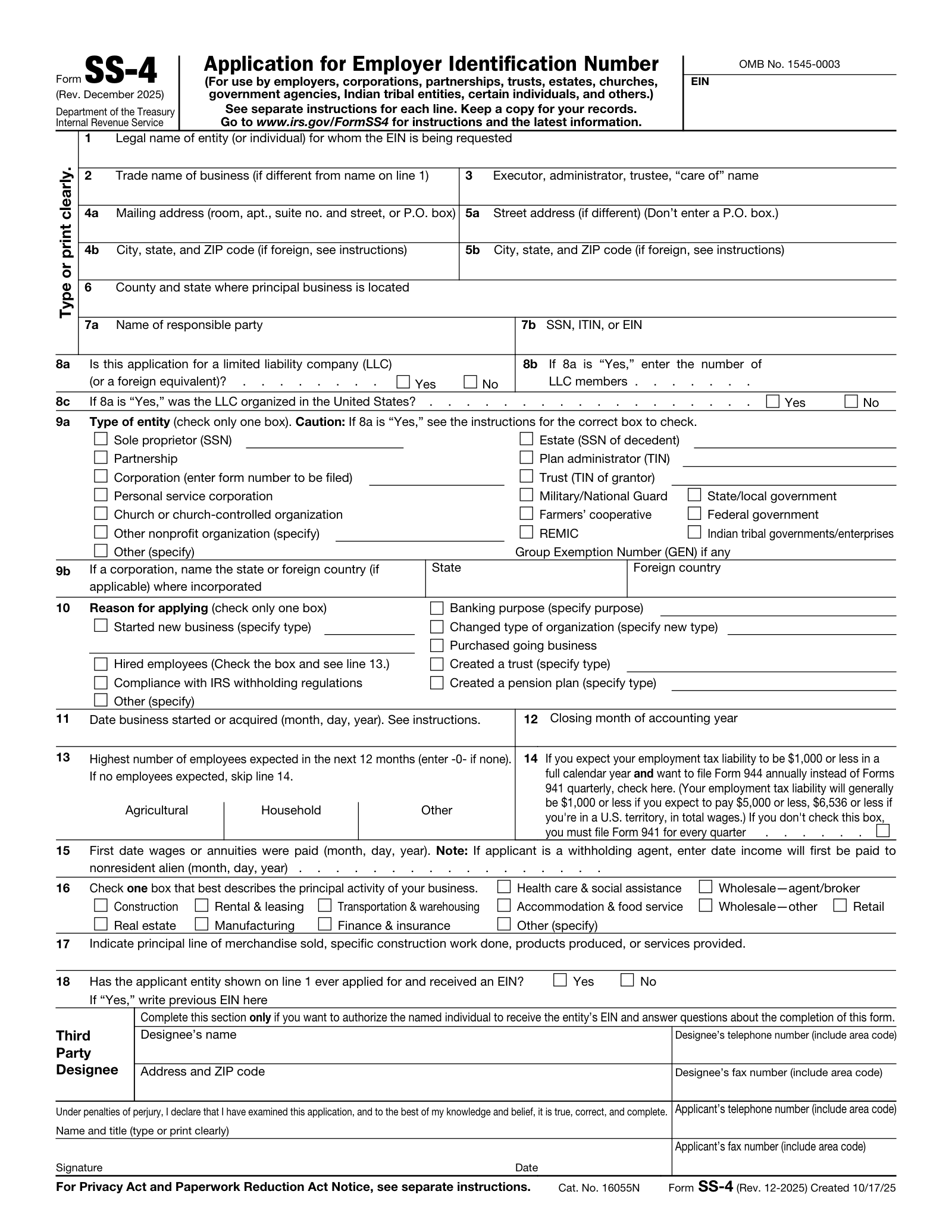
Official form (IRS.gov): Form SS-4 official PDF
Line by line, for a non-resident single-member LLC:
- Line 1 - legal name of the LLC, exactly as the state registered it.
- Line 7a - the responsible party's name. That is you, the owner. Not your agent, not a nominee.
- Line 7b - your SSN/ITIN. Write Foreign.
- Line 8 - check "Other" and write "Foreign-owned single-member LLC."
- Line 9 - check "Started new business."
- Line 10 - reason: banking, or "Banking" plus "Federal tax filing."
- Line 18 - leave blank if you have no US employees.
The name on your SS-4 must match the name on your state formation document character for character. A mismatch is the single most common cause of a rejected EIN application, and it cascades into bank rejections later.
Timeline: fax is typically faster - around four business days - while mail runs four to six weeks. The IRS returns your EIN on a CP 575 notice, or a 147c letter if you need a replacement later.
EIN is not ITIN. You do not need an ITIN to form an LLC, get an EIN, or open a US business bank account. An ITIN is for personal US tax filings, and it is a separate application. If you do need one later, how to apply for an ITIN walks through Form W-7.
If the SS-4 and the fax back-and-forth feel like too much, getting an EIN as a non-US resident is the shortcut.
What should you do in your first 30 days after the LLC is approved?
Four things, in this order: open a bank account, sign an operating agreement, set up bookkeeping, and put every filing deadline in your calendar.
Banking. Online-first providers are the realistic route for non-residents. Mercury, Wise Business, and Payoneer all publish non-resident-friendly onboarding as of early 2026. Traditional US banks typically want you in a branch, in person. Either way, expect KYC: passport, EIN letter, formation documents, and proof of address. An LLC makes you eligible to apply - approval is the provider's decision, and no one can promise it.
A common snag: your LLC is in Wyoming, your passport is Indian, and the bank asks for proof of address. A utility bill or bank statement in your name at your Indian address usually satisfies it. If it does not, ask the provider what they accept before you start a second application - repeated rejected applications make the next one harder.
Operating agreement. Not filed with the state in most cases, but banks and payment processors ask for it. Sign one even as a single-member LLC. It should name you as the sole member, state the ownership percentage, and describe how the LLC is managed.
Tax calendar. For a foreign-owned single-member LLC, the annual filing is Form 5472 attached to a pro-forma Form 1120, due by April 15 or the extended deadline. The penalty for failing to file is $25,000 per year. This applies even if the LLC had zero US activity and zero income.
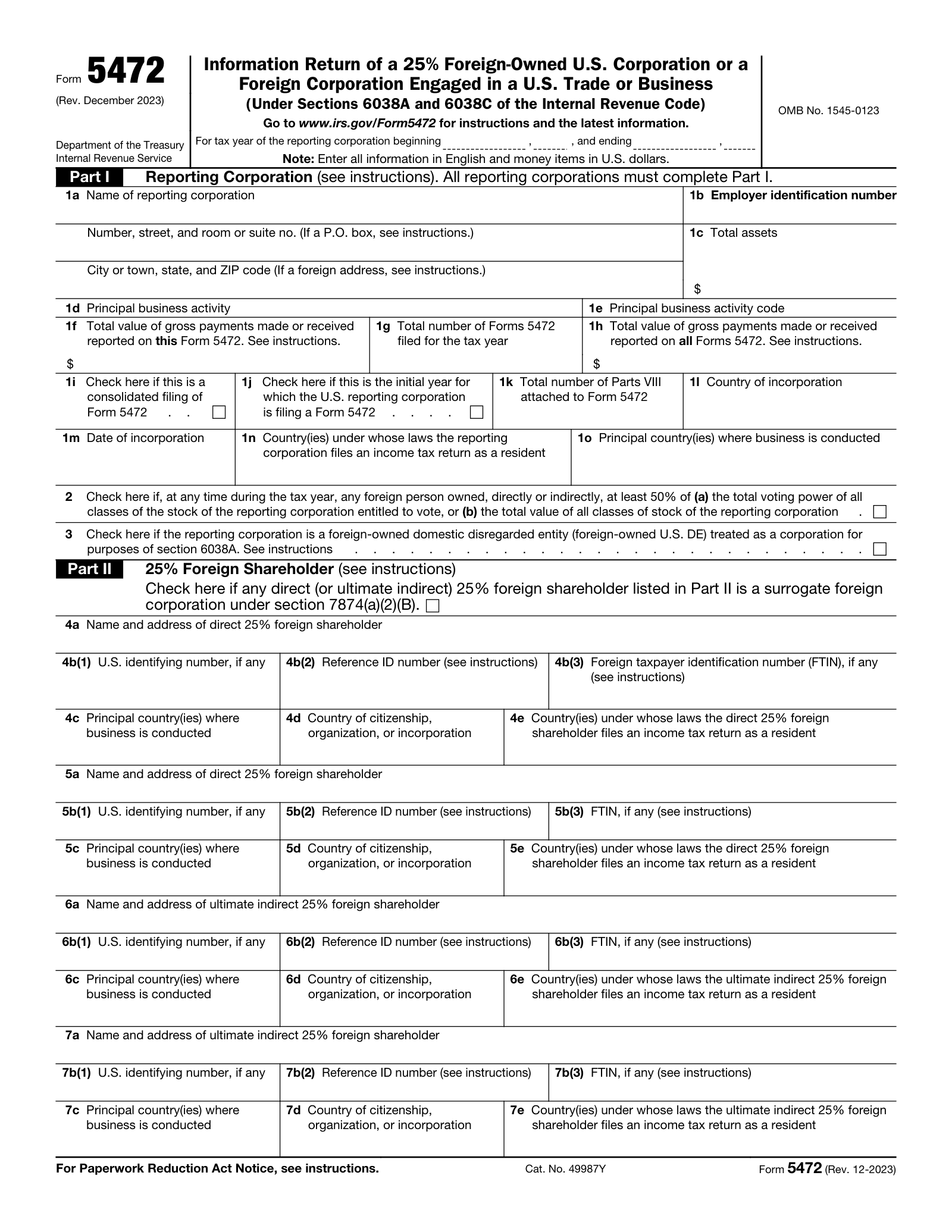
Official form (IRS.gov): Form 5472 official PDF
State compliance. Calendar your annual report or franchise tax date and your registered agent renewal. Miss the annual report and the state will administratively dissolve the LLC - which freezes your bank account and breaks your payment processing.
Tax treatment is not one number. What you actually owe depends on your ownership structure, whether the income is US-source or effectively connected, whether an India-US treaty provision applies, your state nexus, and your entity classification. Talk to a qualified tax professional about your situation. For the federal filings themselves, Form 5472 and Form 1120 support is where most non-residents start.
What mistakes do non-residents make when forming a US LLC?
The most common mistakes are choosing a state for the wrong reason, skipping Form 5472, using a PO box as a registered agent address, and assuming an ITIN is required first.
Forming in Delaware or Wyoming because everyone does. Delaware is built for venture-backed startups. If you are a freelancer or a small agency, you are paying a higher annual franchise tax for a benefit you will never use.
Not filing Form 5472 with the pro-forma 1120. The $25,000 penalty applies even with zero US activity. This is the most expensive mistake on the list, and it is entirely avoidable.
Using your own foreign address as the registered agent address. Invalid in every state. The filing gets rejected, or worse, approved and then flagged.
Confusing an EIN with an ITIN. You do not need an ITIN to form an LLC or open a business bank account. Waiting for one delays everything by months.
Ignoring state annual report deadlines. Administrative dissolution is quiet. You find out when a client payment fails.
Assuming the LLC removes US tax obligations. It does not. A foreign-owned single-member LLC still has US filing duties every year.
Name mismatches. The LLC name on your SS-4, your bank application, and your state filing must be identical. "Aurora Tech LLC" and "Aurora Technologies LLC" are two different companies to a compliance system.
Frequently Asked Questions
Do I need an SSN or ITIN to open a US LLC as a non-resident? No. You need an EIN, which you get with Form SS-4 by fax or mail. Write "Foreign" or "N/A" in the SSN field. An ITIN is only for personal US tax filings.
Can I open a US business bank account without visiting the US? Yes, with online-first providers like Mercury, Wise Business, or Payoneer. Traditional US banks usually require an in-person visit. Expect KYC: passport, EIN letter, formation documents, and proof of address.
Which state is best for a non-resident LLC? Wyoming and Delaware are the most common picks; New Mexico and Florida are also popular. The right choice depends on annual fees, privacy, and whether you have US operations. There is no single best state.
Do I have to file US taxes if my LLC makes no money in the US? Yes, if you are a foreign-owned single-member LLC you must file Form 5472 with a pro-forma Form 1120 every year, even with zero activity. The penalty for not filing is $25,000.
How long does it take to form a US LLC from abroad? State approval typically takes 1-14 days depending on the state and expedite option. The EIN adds about four business days by fax, or four to six weeks by mail. Banking can take another one to three weeks.
Can I be my own registered agent as a non-resident? No. A registered agent must have a physical US street address and be available during business hours. Non-residents hire a commercial registered agent or use a trusted US contact.
If you want help with US LLC formation, EIN and business setup, NexFyla can assist - including the parts most people get stuck on, like the SS-4 and the first bank application.
*Last updated: February 2026.*
Sources
- [1] Stripe - How to open an LLC in the USA for nonresidents: https://stripe.com/resources/more/how-to-open-an-llc-in-the-usa-for-nonresidents
- [2] Wise - How to Open an LLC for non-US residents: https://wise.com/us/blog/llc-for-non-us-residents
- [3] Stripe - How to open an LLC in the USA for nonresidents (step-by-step): https://stripe.com/resources/more/how-to-open-an-llc-in-the-usa-for-nonresidents
- [4] Wise - How to Open an LLC for non-US residents (naming): https://wise.com/us/blog/llc-for-non-us-residents
- Form SS-4 (IRS): https://www.irs.gov/pub/irs-pdf/fss4.pdf
- Form 5472 (IRS): https://www.irs.gov/pub/irs-pdf/f5472.pdf