Table of Contents
▼
Who actually needs an ITIN, and who does not?
An ITIN is for a person who has a US tax filing or payment obligation but cannot get a Social Security Number. If you are a nonresident alien with US-source income, a resident alien, the spouse or dependent of a US taxpayer, or a nonresident claiming a treaty benefit, you are in the eligible group [4][7][9].
Quick Answer: An ITIN is a 9-digit personal tax processing number issued by the IRS to people who need to file or pay US tax but cannot get a Social Security Number. It is not a work permit, not a green card, and not a business number. Your LLC gets its own number, the EIN, on Form SS-4. You get the ITIN as an individual.
Here is the distinction that trips up almost every founder who writes to us.
| Number | Who it belongs to | How you get it | What it is used for |
|---|---|---|---|
| SSN | A US citizen or authorized worker | Social Security Administration | Everything |
| EIN | Your LLC or corporation | Form SS-4 | The company's tax filings, bank account, payroll |
| ITIN | You, personally | Form W-7 | Your personal US tax filings and forms that ask for your individual TIN |
A single-member LLC owned by a non-resident is a disregarded entity for US tax purposes. It files Form 5472 with a pro forma Form 1120, and the owner's identifying number goes on the 5472. If you do not have an SSN, that number is your ITIN. This is the most common reason a non-resident founder needs one.
You do not need an ITIN to open a US business bank account, to register a [INTERNAL LINK: US LLC formation], or to get paid by most platforms. You need it when a US tax form requires your personal taxpayer number.
What does Form W-7 ask for, field by field?
Form W-7 collects your legal name, mailing address, foreign address, date of birth, country of citizenship, and the reason you are applying. The reason you select drives everything else: which documents you attach, and whether a tax return must go in the envelope with it [3][6].
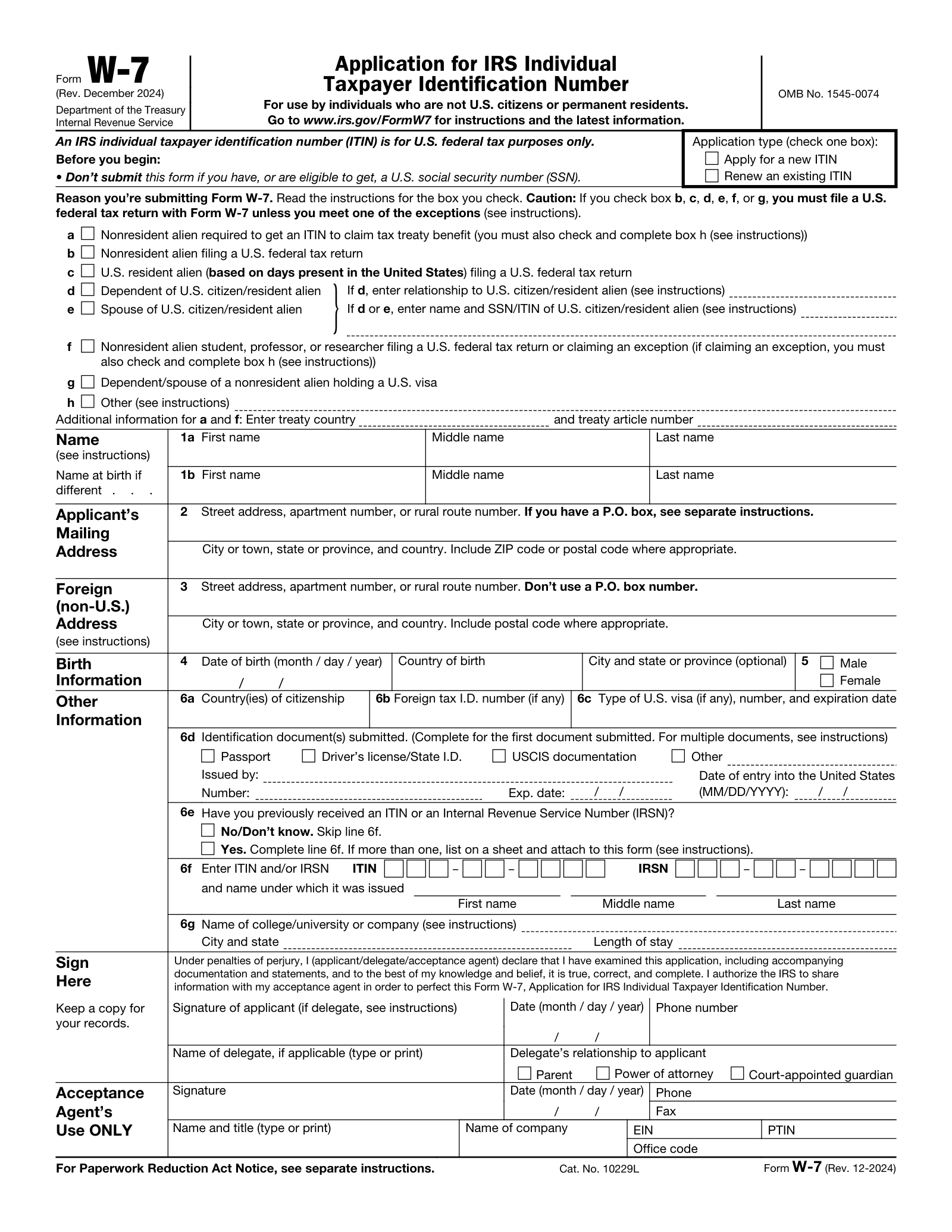
Official form (IRS.gov): Form W-7 official PDF
Walk through the form in this order.
Name lines. Enter your name exactly as it appears on your passport. If your passport shows a surname and given names in a particular order, match it. A W-7 where the name does not match the supporting document gets rejected.
Address lines. You give both a US mailing address (if you have one) and your foreign address. The foreign address supports the foreign status side of your application.
Date of birth and country of citizenship. Straightforward, but they must match your documents.
Reason for applying. This is the field people get wrong. The W-7 has a set of reason boxes, and the box you tick determines whether you must attach a federal tax return. Tick the box for a treaty benefit and you may not need a return. Tick the box for "nonresident alien filing a US tax return" and you must attach one. The current list of reason codes and which ones waive the return requirement lives in the Form W-7 instructions -
Signature and date. An unsigned W-7 is rejected. No exceptions, no follow-up letter asking you to sign it.
Each applicant files a separate W-7. Your spouse and each dependent needs their own form, their own documents, and their own signature [6].
Once issued, the ITIN goes on your federal tax return, on Form 5472 if you own a foreign-owned single-member LLC, and on Form W-8BEN when you claim a treaty rate on US-source income.
Which identity and foreign status documents does the IRS accept?
You must prove two separate things: who you are, and that you are not a US person. Documents must be current, not expired on the date you submit the package [1]. A passport is the only single document that proves both identity and foreign status on its own [2].
If you have a valid passport, use it. That is the whole answer for most readers.
If you do not, the IRS accepts a combination. The accepted categories include a national identification card showing photo, name, current address, date of birth and expiration date; a US driver's license; a foreign driver's license; a birth certificate; voter registration; and a US visa, paired so that one document covers identity and another covers foreign status [2].
Three ways a copy can be acceptable:
- The original document. Mailed in, returned to you later.
- A certified copy from the issuing agency. Your passport office or national ID authority certifies it.
- A copy certified by a Certifying Acceptance Agent (CAA). A CAA is an IRS-approved intermediary who verifies your original documents and certifies copies, so you never mail your passport.
A notarized copy is not accepted. This is the number one rejection trigger we see described, and it is easy to understand why: a notary confirms that a signature happened in front of them, not that the underlying document is genuine. The IRS wants the issuing authority or a CAA in the chain, not a notary [1][2].
Applying from India, mailing the original passport is the standard route. The IRS accepts Form W-7 by mail accompanied by original documents or certified copies, and returns the originals [8]. It feels wrong to put your passport in a courier envelope. It is nonetheless the normal path, and a CAA is the alternative if you would rather not.
When must you attach a tax return to the W-7?
Most first-time applicants must attach a completed federal tax return. The W-7 instructions list specific exceptions where no return is needed - a treaty benefit claim, certain third-party withholding situations, passive income, and a few others [6].
The exception you rely on must match the reason box you ticked. Tick the treaty box and attach nothing, but send documents that do not support a treaty claim, and the application comes back.
If you do file with a return, the sequencing matters: the return is processed only after the ITIN is issued. The two timelines stack rather than run in parallel.
For a non-resident LLC owner, the relevant filing is usually Form 5472 with a pro forma Form 1120, not a personal 1040. Whether you attach anything to the W-7 depends on which reason box applies to you. Get that determination right before you mail anything -
Where do you send the application, and how long does it take in 2026?
Three routes: mail the package to the IRS ITIN address in the W-7 instructions, apply through a Certifying Acceptance Agent, or visit an IRS Taxpayer Assistance Center in person if you are physically in the US [6][8].
Processing time is where expectations break. The IRS commonly cites around 7 to 11 weeks for first-time applications, and longer during peak season from January through April. Renewals and applications filed with a return can run on different clocks -
Practical notes for applicants in India:
- Send by a trackable courier and keep the tracking number. You will want it.
- Photocopy or scan every document before it leaves your hands.
- Originals come back by regular mail, not courier. Plan for that.
- Check status with the IRS ITIN status tool -
- If documents have not returned well past the stated window, contact the IRS rather than resubmitting.
Why do ITIN applications get rejected, and how do you avoid it?
Five causes cover most rejections: expired documents, notarized instead of certified copies, a missing tax return when one was required, a reason box that does not match the attached documents, and an unsigned or incomplete W-7 [1][2].
Map each one back to the form:
| Rejection | The rule it broke | Self-check |
|---|---|---|
| Expired passport or ID | Documents must be current on submission date [1] | Check expiry against your mailing date, not today |
| Notarized copy | Only original, issuing-agency certified, or CAA certified [2] | Look at who signed the certification |
| No tax return attached | Reason box requires one | Re-read the reason box against the instructions |
| Reason box mismatch | Exception claimed but not supported | Does your document set prove the exception? |
| Unsigned W-7 | Signature required | Sign and date every form, including dependents' |
A rejection letter means resubmission from scratch. The clock resets. That is the entire cost of getting it wrong, and it is why the checklist below is worth ten minutes.
Pre-submission checklist:
- Every W-7 signed and dated
- Passport or ID not expiring within the next several months
- Documents current on the date you mail
- Reason box matches your documents and your return situation
- Tax return attached if your reason box requires one
- Certified copies from the issuing agency or a CAA, never a notary
- Separate W-7, documents and signature for each family member
- Copies of everything retained
Common mistakes non-residents make with the ITIN application
Treating the ITIN as a substitute for the EIN is the first one. They are different numbers for different taxpayers, and the LLC's bank account or [INTERNAL LINK: EIN for non-US residents] application does not need your ITIN.
Assuming an ITIN gives work authorization or makes you a US tax resident. It does neither. It is a processing number [9].
Sending a W-8BEN to claim a treaty benefit without an ITIN. The form asks for your taxpayer identification number, and for most non-residents claiming treaty rates that number is the ITIN.
Mailing notarized copies because a notary was easier to find than a CAA. Rejection.
Forgetting that dependents and spouses need their own W-7, their own documents, and their own signature [6].
Letting the ITIN lapse. An ITIN expires after three consecutive years of not being used on a federal tax return, and then must be renewed [4]. A founder who forms an LLC, gets an ITIN, and then has three quiet years will be renewing from scratch.
How does the ITIN fit with the other IRS forms a non-resident founder files?
The ITIN is your personal number on the forms your US entity or payer requires: Form 5472 for a foreign-owned single-member LLC, Form 1120 for the corporation, and Form W-8BEN or W-8BEN-E for treaty and withholding claims.
The sequence that works:
- Form the LLC.
- Get the EIN on Form SS-4.
- Apply for the owner's ITIN on Form W-7.
- File Form 5472 with the pro forma Form 1120.
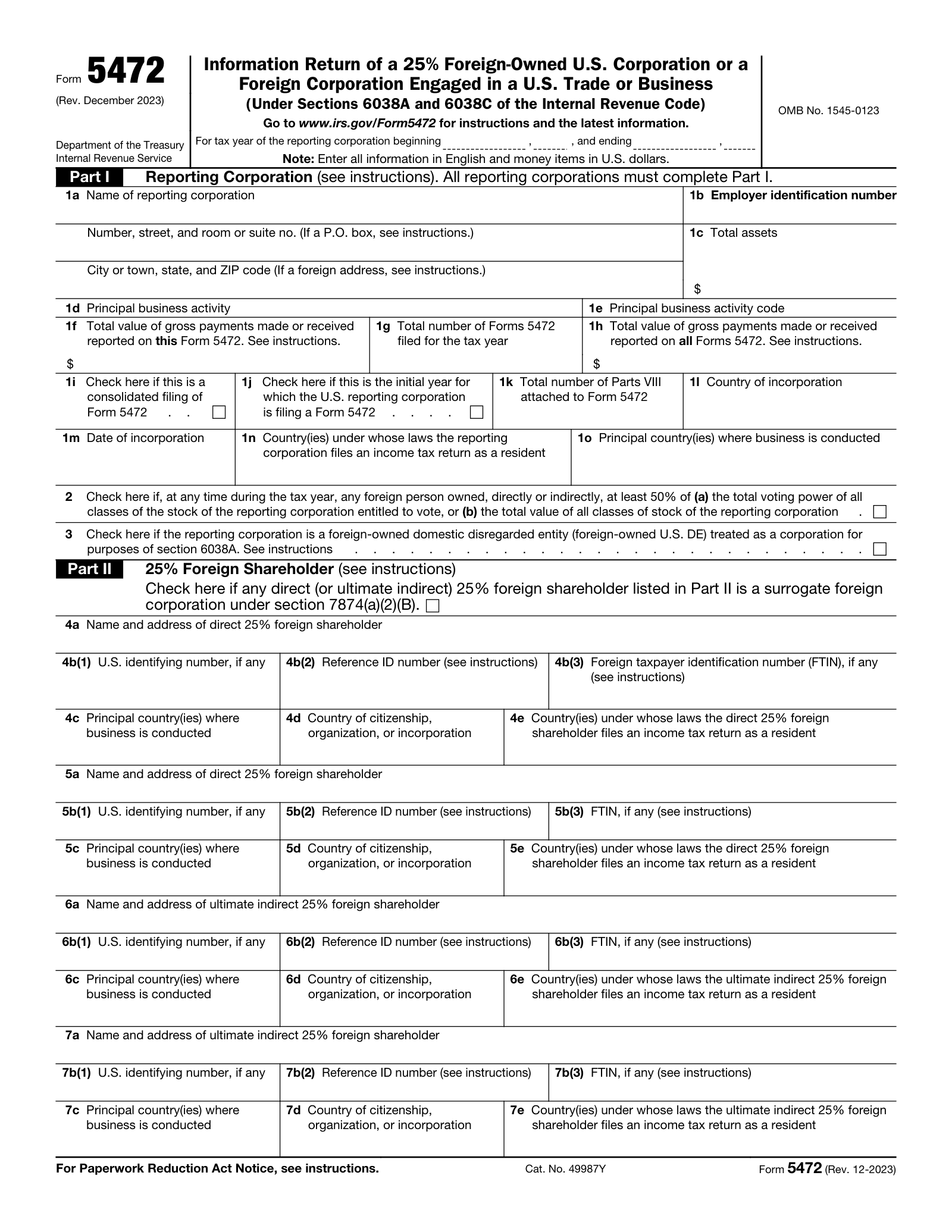
Official form (IRS.gov): Form 5472 official PDF
Two clarifications. Form 8832 only matters if you elect to change the entity's tax classification; it does not replace the ITIN and does not create one. And Form W-9 is for US persons - non-residents generally provide W-8BEN or W-8BEN-E instead.
None of this is tax advice for your specific situation. Ownership structure, US-source and effectively connected income, treaty position, state nexus and entity classification all change the answer, and a qualified tax professional should look at your facts before you file.
Frequently Asked Questions
Can a non-resident apply for an ITIN without a US tax return? Yes, but only under specific exceptions listed in the W-7 instructions, such as a treaty benefit claim, certain withholding situations, and passive income. Otherwise a return must be attached.
Is a notarized copy of my passport acceptable for the ITIN application? No. The IRS requires the original or a copy certified by the issuing agency or a Certifying Acceptance Agent. Notarized copies are rejected [2].
How long does an ITIN application take in 2026? Commonly around 7 to 11 weeks for first-time applications, longer in peak season. Renewals and return-attached applications can differ. Check the current IRS timing before you plan around it.
Does an ITIN expire? Yes. It expires after three consecutive years of not being used on a federal tax return, and must be renewed [4].
Do I need an ITIN if I own a US LLC as a non-resident? The LLC needs an EIN on Form SS-4. The owner typically needs an ITIN to be reported on Form 5472 filed with the pro forma Form 1120.
Can I apply for an ITIN from India? Yes - by mailing the W-7 package with original or certified documents to the IRS ITIN address, or through a Certifying Acceptance Agent [8].
If you want help with US LLC formation, EIN and business setup, NexFyla can assist - including coordinating the ITIN paperwork so the reason box, the documents and the attached return all line up before anything is mailed.
*Last updated: February 2026.*
Sources
- [1] ITIN supporting documents, Internal Revenue Service - https://www.irs.gov/tin/itin/itin-supporting-documents
- [2] Revised application standards for ITINs, Internal Revenue Service - https://www.irs.gov/individuals/revised-application-standards-for-itins
- [3] About Form W-7, Internal Revenue Service - https://www.irs.gov/forms-pubs/about-form-w-7
- [4] Individual taxpayer identification number (ITIN), Internal Revenue Service - https://www.irs.gov/tin/itin/individual-taxpayer-identification-number-itin
- [6] How to apply for an ITIN, Internal Revenue Service - https://www.irs.gov/tin/itin/how-to-apply-for-an-itin
- [7] Individual taxpayer identification number (ITIN) - Who's eligible, Internal Revenue Service - https://www.irs.gov/tin/itin/individual-taxpayer-identification-number-itin
- [8] Obtaining an ITIN from abroad, Internal Revenue Service - https://www.irs.gov/individuals/international-taxpayers/obtaining-an-itin-from-abroad
- [9] Taxpayer identification numbers (TIN), Internal Revenue Service - https://www.irs.gov/tin/taxpayer-identification-numbers-tin