Table of Contents
▼
Why do non-residents form US LLCs in the first place?
A US LLC gives a non-resident founder three things that are hard to get as a foreign individual: US payment rails, a US business bank account, and the appearance of permanence that US clients look for before signing a contract. It does not save you tax by default, and it does not give you any immigration status.
Quick Answer: Non-residents form US LLCs mainly to accept USD payments through Stripe, PayPal and US business banks, and to look more credible to US clients and enterprise buyers. Most US states allow non-citizens and non-residents to own an LLC, and you do not need a visa or an SSN to do it. Ownership of a US LLC is separate from the right to live or work in the US.
That distinction trips up a lot of people. You can own 100% of a Wyoming LLC from Bengaluru and never set foot in the US. What you cannot do is use that LLC as a work permit.
Ownership rules are open. The IRS states that most states do not restrict LLC ownership, and members may include individuals, corporations, other LLCs and foreign entities [9]. Formation services confirm the same thing in plainer language: non-US residents can legally form an LLC or Corporation in any US state without citizenship, residency, or a visa [1].
The pull is commercial, not legal. A US entity makes it easier to sign US contracts, invoice in USD, and get paid by clients who would otherwise balk at wiring money to a personal account in another country [5]. If your customers are US companies, that matters more than the tax angle.
What do you actually get - Stripe, banking, and US clients?
You get the *ability to apply* for US payment processing and business banking. Approval is a provider decision, not a right that comes with your LLC.
Stripe publishes a step-by-step guide for non-residents opening a US LLC, which tells you the path is supported [8]. That is a claim about Stripe's own onboarding flow, not a promise that your specific application gets approved. Mercury, Relay, Wise Business and Payoneer each run their own KYC checks, and their non-resident policies change without much warning.
What almost every provider wants to see:
- An EIN (Employer Identification Number - the IRS tax ID for your company)
- Your Articles of Organization (the state filing that creates the LLC)
- A US business address - usually your registered agent's address or a mail forwarding service
- Identity documents for every member with 25%+ ownership
Some providers accept an ITIN (Individual Taxpayer Identification Number) instead of an SSN. Some want a US phone number. A few will not onboard certain countries at all.
Heads-up: bank and processor policies for non-resident LLCs shift constantly. Check the provider's current requirements the same week you plan to apply, not from a blog post written two years ago.
The credibility piece is real but soft. US enterprise buyers treat a US entity as a signal that you will still be around next year [5]. That is worth something in a procurement process, and nothing at all if you sell to customers in your home market.
What are the tax implications non-residents must understand before forming?
A single-member LLC owned by a non-resident is usually a disregarded entity for US federal tax - the IRS ignores the LLC and looks at you, the owner. You still have to file an annual information return, and your home country may still tax the income.
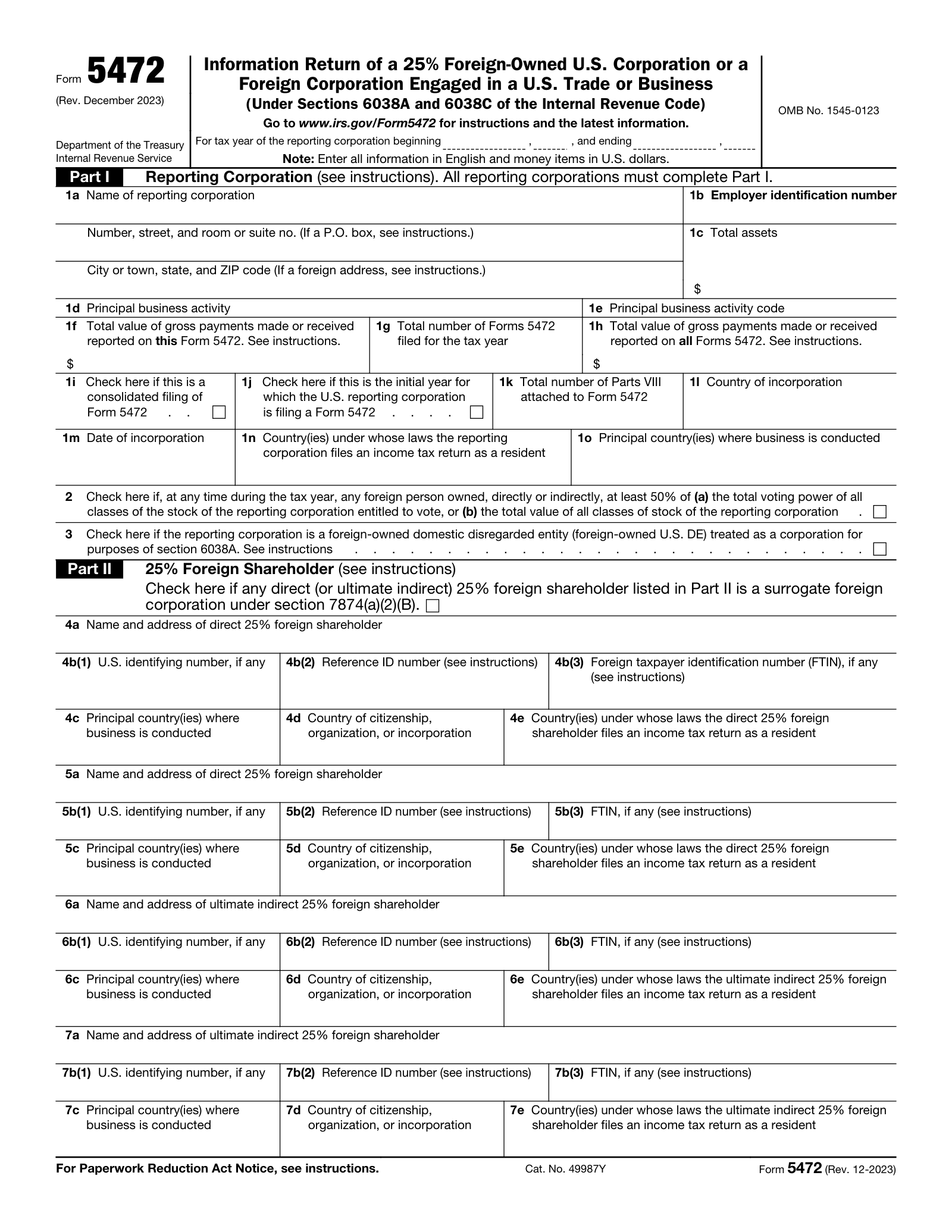
Official form (IRS.gov): Form 5472 official PDF
Here is the part most formation guides bury. A foreign-owned single-member LLC must file Form 5472 together with a pro-forma Form 1120 every year - even in a year with zero US activity, zero revenue, and zero bank transactions. The penalty for failing to file is $25,000 per year That is not a rounding error. It is larger than the entire cost of forming and running the LLC for a decade.
On income tax itself, the picture is fact-dependent. If you have no US-source income, no US employees, and no dependent agent in the US, you may not owe US federal income tax. Change any one of those facts and the answer changes. This is where you talk to a qualified tax professional rather than a blog.
The default classification rules come from the IRS, not from your formation agent [9][13]. An LLC with one member is disregarded by default; an LLC with two or more members is treated as a partnership by default unless it elects otherwise. You can elect to be taxed as a corporation by filing Form 8832, but that is a deliberate choice with its own consequences.
For multi-member LLCs and corporations, the analysis shifts. Corporations face the 21% federal rate and possible branch profits tax considerations, and a C-Corp's ability to issue unlimited stock is what makes it attractive to investors [2][6].
One more thing people miss: your home country may tax your worldwide income regardless of where the LLC is registered. Forming in Wyoming does not move your personal tax residence. If you are an Indian resident, your global income is generally taxable in India -
What is the real compliance burden and cost of a US LLC?
Formation is cheap. Staying compliant is not. Budget for three separate cost buckets and never blend them into one number.
1. Government fees - paid to the state and the IRS. State filing fees, annual report fees or franchise taxes, plus nothing to the IRS for the EIN itself.
2. Provider fees - paid to private companies. Registered agent service, mail forwarding, formation service markup.
3. Professional fees - paid to a CPA or accountant. Form 5472 and pro-forma 1120 preparation, bookkeeping, and any state tax filings.
Every LLC needs a registered agent with a US address - the person or company that receives official state documents on your behalf [7]. Typical registered agent pricing runs from about $50 to $300 per year depending on the provider [7].
State costs differ enough that the choice matters:
| State | Formation fee | Annual obligation | Registered agent required |
|---|---|---|---|
| Wyoming | Check the current official fee | Annual report + license tax | Yes |
| Delaware | Check the current official fee | Annual franchise tax | Yes |
| New Mexico | Check the current official fee | No annual report for LLCs | Yes |
| Florida | Check the current official fee | Annual report | Yes |
Note: the annual report or franchise tax is usually the bigger long-term cost, not the initial filing fee.
Heads-up: miss the state annual report and you get late fees, then administrative dissolution. Miss Form 5472 and you get a $25,000 penalty. Set both deadlines in your calendar the day the LLC is approved.
When is a US LLC the wrong choice for a non-resident?
If you have no US customers, no need for US payment processing, and no plan to raise from US investors, a US LLC adds cost and paperwork for very little return.
Ask yourself honestly:
- Do you sell to US clients or want to? If no, the credibility benefit is theoretical.
- Do you need Stripe, PayPal or a US bank account? If your local payment stack works, you are buying complexity.
- Will you actually file every year? If the answer is "maybe," the $25,000 penalty risk outweighs everything else.
- Is your only motive lower tax? A US LLC rarely delivers that on its own. You need an actual tax plan, and often a treaty analysis.
- Stay a sole proprietor in your home country and invoice internationally.
- Form a local entity where you actually live and work.
- Use a merchant-of-record like Paddle or Lemon Squeezy, which handles US sales tax and payment collection as the seller of record. If your only blocker is "I cannot get Stripe," this is often the cheaper fix.
Alternatives that solve the real problem for less:
And the hard line: an LLC does not give you a visa, work authorization, or US tax residency [14]. Founders on Reddit debate "to open a US LLC or not" constantly, and the hesitation is usually well-founded [7].
How do you decide? A simple framework for international founders
Score yourself on four questions. Two or more "no" answers means pause before you file.
- Do you have or want US customers? Yes is a strong signal.
- Do you need US payment processing or a US business bank account? Yes is a strong signal.
- Can you commit to annual Form 5472, pro-forma 1120, and state reports? No is a stop sign.
- Does your home-country tax position make this worthwhile? Uncertain means get advice first.
If you clear all four, pick a state based on your actual needs - privacy, annual cost, franchise tax - rather than whatever a YouTube video defaults to. Delaware makes sense for VC-backed startups; it is usually the wrong pick for a solo consultant with no Delaware presence.
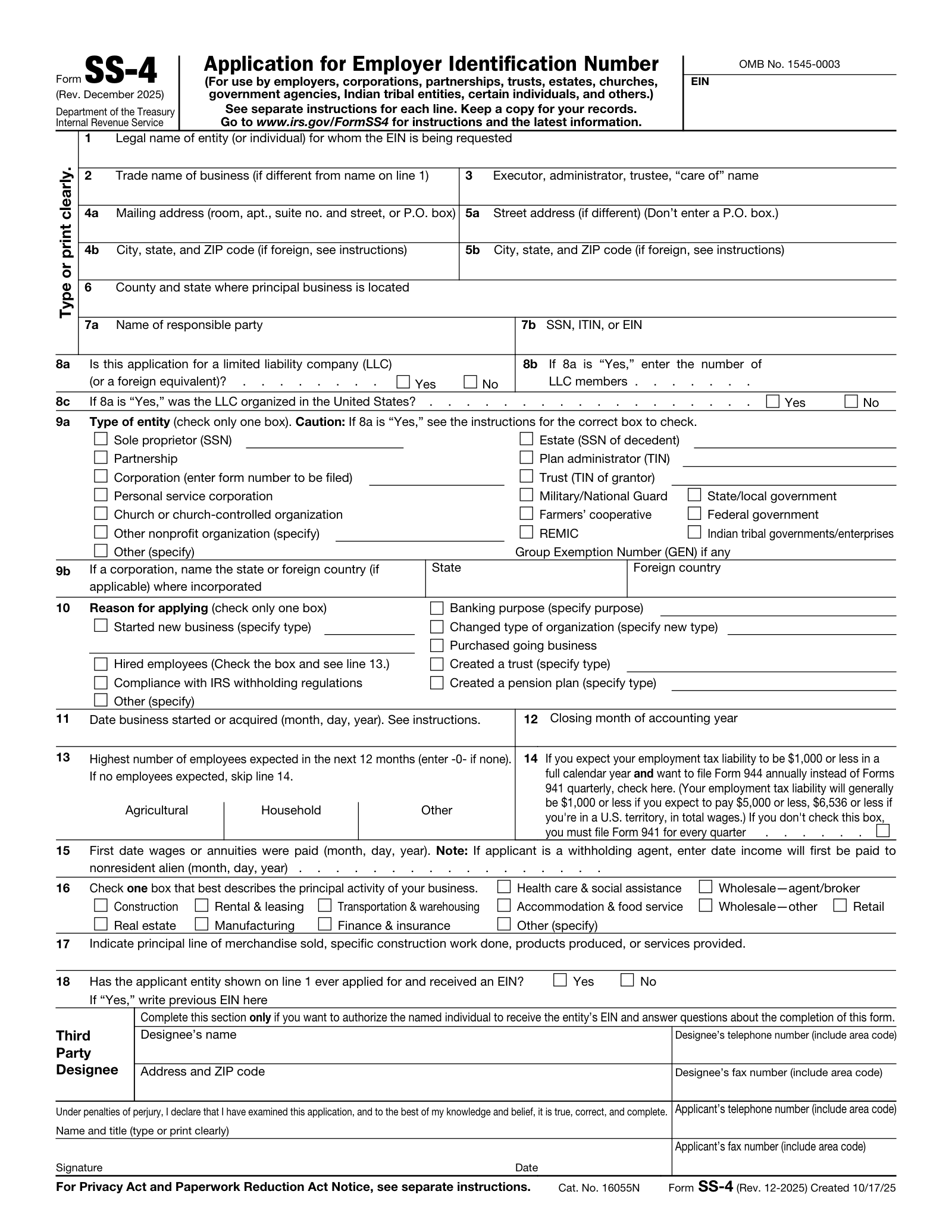
Official form (IRS.gov): Form SS-4 official PDF
Then plan the paperwork that actually comes up in practice: Form SS-4 for your EIN, W-8BEN or W-8BEN-E to certify foreign status to US payers, and W-9 only if you are a US person. Non-residents applying for an EIN do not need an SSN [11].
Before you file anything, put two recurring calendar reminders in place: your state annual report date and your Form 5472 due date.
Common Mistakes
Skipping Form 5472 because you had no US income. The filing is required for foreign-owned single-member LLCs regardless of activity. This is the single most expensive mistake on this list.
Picking Delaware by default. Delaware franchise tax and registered agent costs make sense for startups raising US venture capital. For an operating consulting business with no Delaware presence, it is an unnecessary bill.
Assuming a US LLC fixes your visa or tax residency. It does neither [14].
Using a registered agent that forwards mail slowly. State notices have deadlines. A slow agent turns a routine annual report into a late fee.
Opening a personal US bank account instead of a business account. This breaks the liability separation that is the entire point of an LLC.
Assuming Mercury or Stripe will approve you. Approval is the provider's decision, and it depends on their current non-resident policy, your business type, and your country.
Ignoring home-country reporting. Many countries require residents to disclose foreign assets and entities.
Frequently Asked Questions
Can a non-resident own a US LLC without a visa or SSN? Yes. Most states do not require citizenship or residency, and you can get an EIN without an SSN using Form SS-4 [1][11]. A visa is only needed to physically work in the US.
Does a US LLC mean I have to pay US taxes? Not automatically. A single-member foreign-owned LLC is usually a disregarded entity, and if you have no US-source income, no US employees and no dependent agent, you may not owe US federal income tax. You still must file Form 5472 annually.
What happens if I don't file Form 5472? The IRS can assess a $25,000 penalty per year for failure to file.
Which state is best for a non-resident LLC? It depends on your business. Wyoming and New Mexico are popular for privacy and low annual costs; Delaware suits startups seeking venture capital; Florida has no state income tax but higher annual fees. Compare annual report costs and franchise taxes before choosing.
Can I open a US business bank account as a non-resident? Some online banks, including Mercury, Relay and Wise Business, accept non-resident LLCs, but policies change. You will typically need an EIN, formation documents and a US address. Verify current requirements directly with the provider.
Is a US LLC worth it if I have no US customers? Usually not. If you do not need US payment processing or US client credibility, a local entity or a merchant-of-record is simpler and cheaper.
Getting the decision right matters more than getting the filing done fast. If you want help with [INTERNAL LINK: US LLC formation], [INTERNAL LINK: EIN for non-US residents] and [INTERNAL LINK: US business bank account] setup, NexFyla can assist.
*Last updated: February 2026.*
Sources
- [1] Setting Up a US Company as a Non-Resident: Complete Guide 2026 - https://www.usa-corporate.com/start-us-company-non-resident/
- [2] How to start a business in the USA as a non-resident | Wise - https://wise.com/us/blog/start-a-business-in-usa-non-resident
- [5] LLC for Foreigners: How to Start a U.S. Company as a Non-Resident - https://globalfy.com/blog/llc-for-foreigners/
- [6] Setting up a U.S. Company as a Non-Resident | Choose New Jersey - https://choosenj.com/blog/setting-up-us-company-non-resident/
- [7] Opening an LLC in the US as an international - r/digitalnomad - https://www.reddit.com/r/digitalnomad/comments/1najtzr/opening_an_llc_in_the_us_as_an_international_how/
- [8] How to open an LLC in the USA for nonresidents - Stripe - https://stripe.com/resources/more/how-to-open-an-llc-in-the-usa-for-nonresidents
- [9] Limited liability company (LLC) | Internal Revenue Service - https://www.irs.gov/businesses/small-businesses-self-employed/limited-liability-company-llc
- [11] How to Open a U.S. LLC for Non-US Residents - 1040 Abroad - https://1040abroad.com/blog/how-to-open-a-u-s-llc-for-non-us-residents/
- [13] Limited liability company (LLC) | Internal Revenue Service - https://www.irs.gov/businesses/small-businesses-self-employed/limited-liability-company-llc
- [14] Setting Up a US Company as a Non-Resident: Complete Guide 2026 - https://www.usa-corporate.com/start-us-company-non-resident/