Table of Contents
▼
Why does state choice matter for non-residents forming a US LLC?
Your state of formation changes your annual fees, your privacy, your legal protections and how investors read your company. It does not change your US federal tax obligations as a non-resident.
Quick Answer: A non-resident can form an LLC in any US state. Wyoming and Delaware are the two most popular because both allow fully remote formation and both have business-friendly laws. Wyoming is cheaper and more private; Delaware is the default choice if you plan to raise venture capital. Federal tax rules apply the same way in either state.
That last sentence is the part most guides bury. The IRS does not care where your LLC was filed. If your single-member LLC is foreign-owned and disregarded, you file Form 5472 with a pro forma Form 1120 every year no matter which state issued your certificate [9]. State choice is a cost, privacy and investor story. Federal tax is a separate story.
What state choice does move:
- Annual cost. Wyoming wants roughly $60/year for its annual report; Delaware wants $300/year in LLC franchise tax [2].
- Privacy. Wyoming does not put member names on the Articles of Organization. Delaware asks for less than people assume, but it is the more disclosed of the two.
- Who takes you seriously. Investors, acquirers and US counsel have seen thousands of Delaware entities. Wyoming reads as a small-business state [6].
- Banking friction. Some providers are more familiar with one state's paperwork than the other, which shows up as extra document requests during onboarding.
If you are still at the "what even is an EIN" stage, start with [INTERNAL LINK: US LLC formation] and [INTERNAL LINK: EIN for non-US residents] before you pick a state. The state decision is easier once the mechanics are clear.
Wyoming LLC for non-residents: costs, privacy, and annual requirements
Wyoming is the cheap, private, low-maintenance option: about $100 to file, about $60/year after that, no state income tax, and no member names on the public formation document [1][2][11].
Here is the full sequence.
1. File the Articles of Organization. Wyoming's filing fee is $100 online. The Articles are the one-page document that legally creates the LLC. You sign as the organizer, not necessarily as a member, which is part of why the public record stays quiet.
2. Appoint a registered agent. Every Wyoming LLC needs a registered agent: a person or company with a physical Wyoming street address who accepts legal mail on your behalf. Budget $50–$150/year for a commercial service. A PO box will not work, and you cannot use your address in India, Dubai or Berlin.
3. Get your EIN. The EIN (Employer Identification Number) is the LLC's federal tax ID. Non-residents apply with Form SS-4, by fax or mail, since the online portal expects a Social Security Number. Expect weeks, not days, for a non-resident application [7].
4. File the annual report. Wyoming's annual report is due on the first day of the anniversary month of formation. The fee is $60 or $0.0002 of Wyoming assets, whichever is greater For a normal software or consulting LLC, it is $60.
5. Keep the agent paid. Miss this and the state can revoke your LLC's good standing, which is the quiet killer of US business bank accounts.
Why non-residents keep landing on Wyoming: it is fast, it is cheap, and the charging order is the exclusive remedy for a Wyoming LLC, which is unusually strong creditor protection [11]. Wyoming is also the state people describe as "super easy and tax friendly" [5][8].
Note: "tax friendly" means no Wyoming state income tax. It does not mean no US federal tax. A Wyoming LLC does not give you zero income tax [5].
Delaware LLC for non-residents: franchise tax, investor expectations, and costs
Delaware costs more and is worth it in exactly one situation: you intend to raise venture capital or be acquired by a US company. Otherwise you are paying $300/year for prestige you will not use.
Costs and mechanics:
- Certificate of Formation: $110. That is the document that creates a Delaware LLC.
- Annual franchise tax: $300, due June 1 every year. Delaware's LLC franchise tax is a flat $300. It is not the complicated authorized-shares calculation that Delaware corporations use, and people mix those up constantly.
- Registered agent: $50–$150/year, same requirement as Wyoming, same physical-address rule.
- No Delaware state income tax on income an LLC does not earn in Delaware
Where Delaware wins is not the paperwork. It is the ecosystem. Delaware is where large companies incorporate [6], which means your future investors' lawyers, your acquirer's counsel and the courts have all done this before. When a US fund's counsel sees a Delaware entity, diligence is routine. When they see a Wyoming LLC sitting under a founder who wants a priced seed round, the first question is always the same: when are you converting?
That is the honest tradeoff. Delaware is not "better." Delaware is more legible to institutional money.
Wyoming vs Delaware LLC: head-to-head comparison table
Wyoming is cheaper and more private. Delaware is more expensive and more investor-legible. Everything else is roughly a tie.
| Item | Wyoming LLC | Delaware LLC |
|---|---|---|
| Formation filing fee | $100 | $110 |
| Annual state fee | $60 (or $0.0002 of assets, whichever is greater) | $300 franchise tax |
| Annual deadline | First day of anniversary month | June 1 |
| State income tax | None | None on income not earned in Delaware |
| Member names public? | No | More disclosure than Wyoming |
| Registered agent required | Yes, physical address | Yes, physical address |
| Remote formation | Yes | Yes |
| Asset protection | Charging order is the exclusive remedy | Standard charging order |
| Investor preference | Small business, bootstrapped | VC, acquisition, US counsel |
| Best for | Cheapest compliant setup | Raising venture capital |
Both states allow you to form the LLC entirely remotely without visiting the US [10]. Both need a registered agent. Neither state's choice changes your federal filing obligations.
One cost trap: the $100 and $110 above are government fees only. Add the registered agent, the EIN process, and any formation service you use. If a provider quotes you a single "all-in" number that blends state fees with their own, ask them to split it.
Decision guide: should you pick Wyoming or Delaware?
Pick Wyoming if you are bootstrapped, selling services or software to non-US or US clients, and have no near-term plan to raise venture capital. Pick Delaware if you plan to raise VC, take US institutional money, or get acquired by a US company.
Run your situation against this:
- Raising venture capital in the next 18 months? Delaware. A Delaware LLC is still not what VCs want (they want a Delaware C-Corp), but it is one conversion away instead of two.
- Using Stripe, PayPal or Wise to collect payments? Either state works. Wyoming is cheaper, and non-residents routinely report it is the easier, lower-cost path [3][12].
- Solo consultant or agency owner, no investors ever? Wyoming. You are paying $60/year instead of $300/year for the same practical outcome.
- Planning to be acquired by a US company? Delaware. Acquirers prefer to buy Delaware entities.
- Want maximum privacy on the public record? Wyoming.
Can you start with Wyoming and switch? Yes. You can convert or reincorporate in Delaware later when you actually raise [4]. Founders do this constantly. The conversion costs money and time, but it is a known, routine process, not a rebuild.
One thing Reddit gets right and wrong at the same time: the loud advice is "Wyoming for non-residents" because it is cheap and simple [1][3]. That is correct for bootstrappers. It is bad advice for someone who knows they are raising, because you will pay for the conversion anyway.
Tax and compliance obligations for non-resident LLC owners
Federal obligations are identical in both states. A single-member LLC owned by a non-resident is disregarded for federal tax purposes by default, and you must file Form 5472 with a pro forma Form 1120 every year, even with no income and no US activity [9].
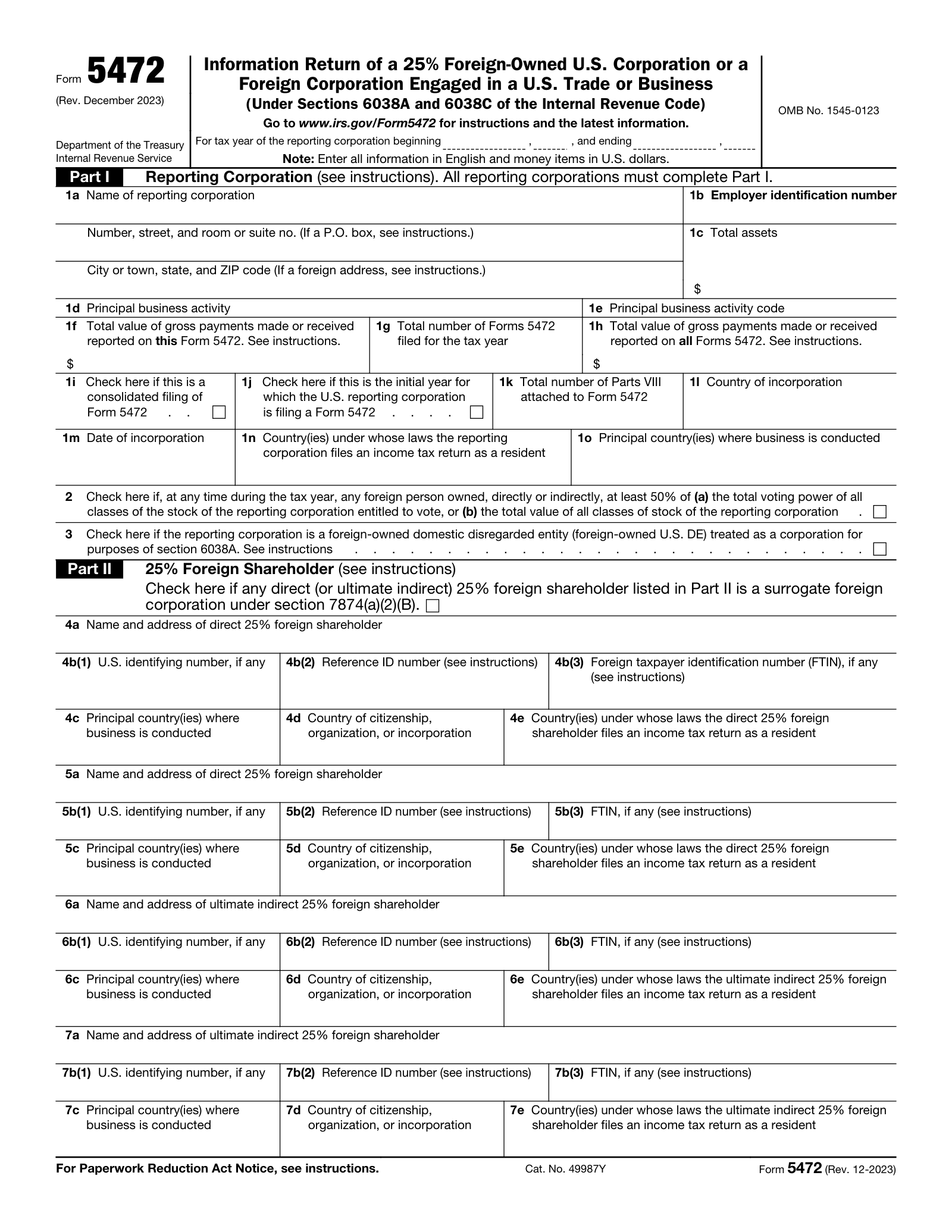
Official form (IRS.gov): Form 5472 official PDF
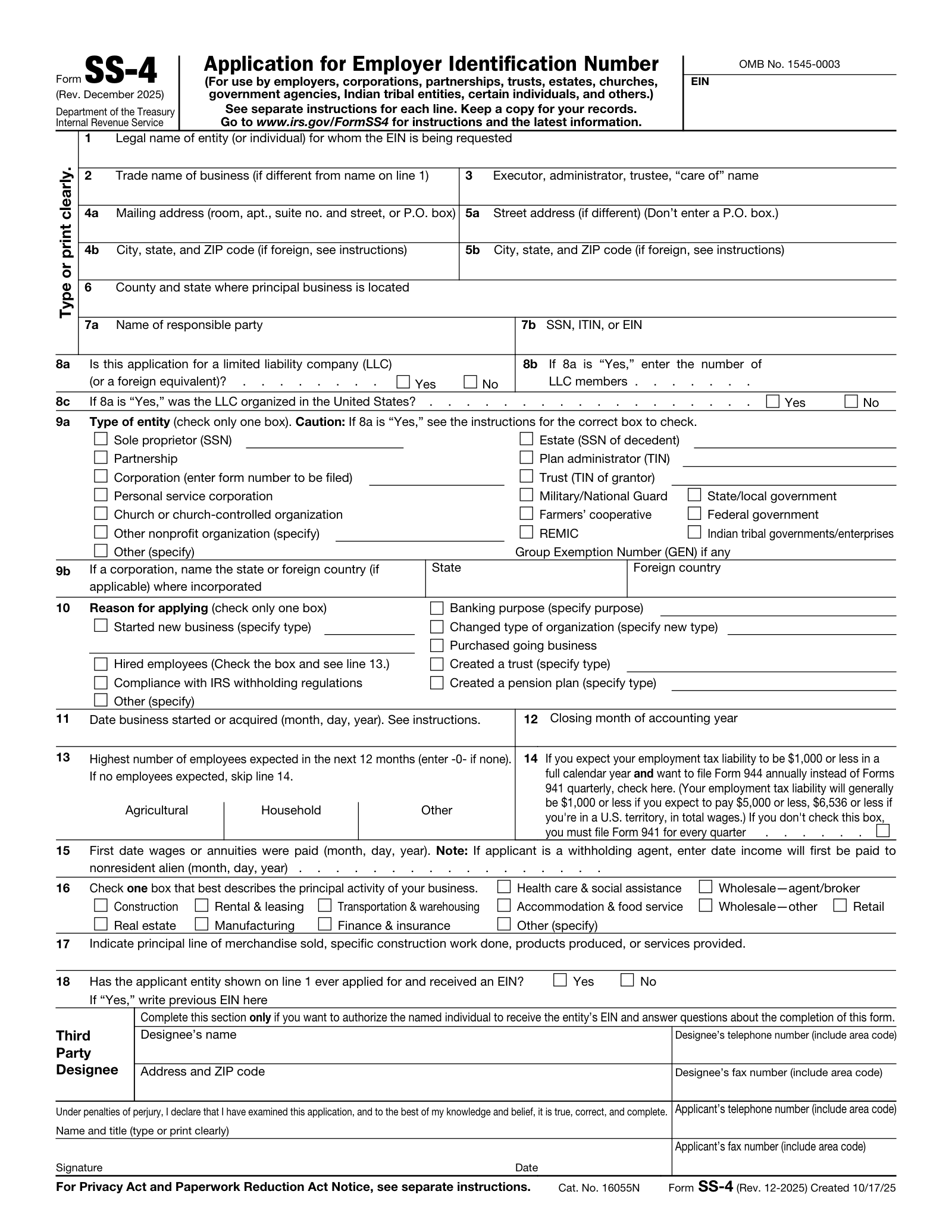
Official form (IRS.gov): Form SS-4 official PDF
The penalty for failing to file Form 5472 is $25,000 per year, plus more for continued non-compliance This is the single most expensive mistake in this entire article, and it has nothing to do with which state you picked.
The rest of the map:
- Form SS-4 gets you the EIN. Non-residents file by fax or mail.
- Form 8832 is how you elect corporate taxation instead of disregarded status, if that ever makes sense for you.
- Form W-8BEN (individuals) or W-8BEN-E (entities) tells a US payer you are foreign so they withhold correctly.
- Form W-7 gets you an ITIN if you personally need to file a US return.
- Form 1120 is the pro forma return that carries your Form 5472.
What actually determines your US tax bill is not the state. It is whether you have US-source income, whether that income is effectively connected income (ECI), whether a US–India treaty or another treaty applies, your entity classification, and whether you have state nexus anywhere. Those variables decide the number. Get a qualified US tax professional who works with non-resident founders before you assume anything, including assuming zero.
State-level: if your LLC never operates in Wyoming or Delaware, you typically owe no state income tax there. If you have a physical presence, employees or a permanent establishment in another US state, that state's rules apply instead.
Common Mistakes
Forming in Delaware "because startups do" with no plan to raise. You pay $300/year instead of $60/year, forever, for a benefit you never collect.
Skipping Form 5472 because the LLC made no money. The filing is required even at zero activity for a foreign-owned disregarded entity [9]. The penalty starts at $25,000.
Letting the registered agent lapse. The state revokes good standing, and banks and Stripe freeze or close accounts when your state registration shows as not in good standing. This is the most common cause of a working account suddenly not working.
Assuming state choice removes US tax. It does not. Wyoming does not give you zero income tax [5].
Mixing up Delaware's LLC franchise tax with the corporate franchise tax. The LLC version is a flat $300. Do not let a forum thread convince you it is a share-based calculation.
Using a home address as the registered agent address. It must be a physical address in the formation state. A virtual mailbox in another country fails.
Name mismatches. The name on the EIN application, the state filing, the bank application and the Stripe account must match. "Acme Labs LLC" on one and "Acme Lab LLC" on another triggers a compliance review that takes weeks to unwind.
Ignoring the annual report deadline. Wyoming's is the first day of your anniversary month. Delaware's is June 1. Neither state sends a friendly reminder that arrives before the penalty.
Frequently Asked Questions
Can a non-resident form a Wyoming or Delaware LLC without visiting the US? Yes. Both states allow online formation, and you use a registered agent service for the physical address. No SSN or US address required [10].
Which state is better for opening a Stripe account as a non-resident? Both are accepted. Wyoming is usually recommended because it costs less to maintain. You still need an EIN and a US business bank account, and approval is Stripe's decision, not yours or ours.
Do I pay US taxes if I form a Wyoming or Delaware LLC but live abroad? You file a US federal return if you have US-source income or meet filing thresholds, and you file Form 5472 + pro forma 1120 regardless. State tax usually does not apply without nexus. Confirm with a tax professional.
What is the annual cost of maintaining each? Wyoming: about $60 annual report plus $50–$150 registered agent. Delaware: $300 franchise tax plus $50–$150 registered agent. Government fees and provider fees are separate.
Can I convert my Wyoming LLC to a Delaware C-Corp later if I raise VC? Yes. Founders do this routinely when they raise [4]. It costs money and time, but it is a standard process.
What happens if I do not file Form 5472? The IRS can impose a $25,000 penalty, with additional penalties for continued non-compliance
Sources
[1] https://www.reddit.com/r/llc/comments/1gdrbdi/why_do_some_recommend_using_wyoming_or_delaware/ [2] https://www.reddit.com/r/llc_life/comments/1pr5bkr/wyoming_vs_delaware_llc/ [3] https://www.reddit.com/r/llc/comments/1gtc9uw/llc_for_a_non_usresident/ [4] https://www.reddit.com/r/fatFIRE/comments/i5gtal/wyoming_vs_nevada_vs_delaware_for_new_llc/ [5] https://www.reddit.com/r/llc/comments/1qwu86f/advice_on_forming_wy_llc_as_non_us_resident/ [6] https://www.reddit.com/r/startups/comments/ic7rah/should_i_incorporate_my_company_as_a_delaware_llc/ [7] https://www.reddit.com/r/llc/comments/1gtc9uw/llc_for_a_non_usresident/ [8] https://www.reddit.com/r/llc/comments/1qwu86f/advice_on_forming_wy_llc_as_non_us_resident/ [9] https://www.reddit.com/r/Business_Ideas/comments/1ui1gxp/wyoming_llc_as_a_nonus_resident_european/ [10] https://www.reddit.com/r/smallbusinessUS/comments/1miam38/how_to_remotely_form_a_wyoming_llc_as_a_nonus/ [11] https://www.reddit.com/r/llc/comments/1u6invf/is_forming_an_llc_in_wyoming_worth_it_if_i_live/ [12] https://www.reddit.com/r/llc/comments/1nwshz4/non_resident_llc_in_wy/
*Last updated: February 2026.*
If you want help with US LLC formation, EIN and business setup, NexFyla can assist.